Sediment-rich rocky habitat,
always associated with rocks.
Occurs at depths ranging from about 3 to 20 m.
Geographic distribution:
Endemic to Chizumulu Island, Lake Malawi.
Typical adult size:
Males up to about 8 cm total length;
females up to about 6 cm.
Sexual dimorphism:
Males display a sky-blue breeding coloration
with a distinctive black band from the eye to the mouth,
continuing around the lower jaw.
Females are cream-white and lack the black facial markings.
Recommended aquarium size:
200 L.
Aquarium setup:
Aquarium with abundant rockwork arranged to create caves and passages.
Fine sand should be used as substrate.
One male should be kept with two to three females.
Several males can be maintained together
if each has access to its own cave.
Suitable tankmates include most Malawi cichlids of similar size,
including mbuna, Aulonocara, and smaller haplochromines,
but larger and aggressive species should be avoided.
Diet:
Insectivorous.
Feeds mainly on small crustaceans, insects, and their larvae,
extracting prey from narrow rock crevices
with long, pointed teeth.
Breeding:
Males are not territorial,
although conspecifics may be chased from feeding sites.
Spawning takes place at any site in the habitat.
The species does not form schools
and individuals operate independently.
Aggression:
Peaceful within the species and toward other species.
Multiple males can be kept together in aquaria
if sufficient shelter is provided.
Special notes:
Males are recognized by their intense sky-blue coloration
and a characteristic black facial band
running from the eye to the mouth and around the lower jaw.
Labidochromis chisumulae closely resembles
Labidochromis sp. 'chisumulae mbweca',
differing mainly in the presence of a wide black band
along the lower margin of the dorsal fin in males,
which is absent in the latter.
Females of both forms are indistinguishable./td>
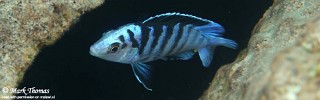
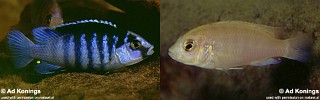





Photo gallery