Mainly inhabits intermediate habitats where rocks and sand meet.
Also occurs in pure rocky areas, over bare sand, and in zones with Vallisneria growth.
Typically found at depths of 3–15 m, occasionally recorded down to about 30 m.
Geographic distribution:
Lake-wide distribution in Lake Malawi, though always occurring at very low population densities.
Typical adult size:
Males up to 30 cm, females up to 26 cm.
Sexual dimorphism:
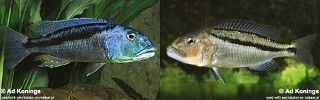
Males grow slightly larger and develop a distinct nuptial coloration during the breeding period.
Females remain somewhat smaller and lack intense breeding coloration.
Recommended aquarium size:
At least 1000 L; aquarium length should be no less than 250 cm.
Aquarium setup:
Use a sandy foreground planted with robust plants such as Vallisneria, combined with extensive rockwork in the background.
Arrange rocks to create numerous passages and hiding places.
Keep one male with two females.
Only house with very large and robust tankmates (at least 50% of its size), such as other large predators or robust Utaka;
smaller fishes will be regarded as prey.
Diet:
Carnivorous piscivore. In the wild, it primarily feeds on relatively large mbuna,
but will also prey on other cichlids within an appropriate size range.
Breeding:
Maternal mouthbrooder. Males develop breeding coloration only for a short seasonal period and occupy temporary territories among rocks.
Females enter these territories to spawn.
Mouthbrooding females hide in caves and crevices and continue to guard the fry for about one month after first release.
Aggression:
Generally peaceful toward sufficiently large tankmates.
Any smaller fish is likely to be hunted and eaten.
Special notes:
Aristochromis christyi is characterized by a narrow diagonal stripe running from the nape to the caudal base
and a highly specialized beak-like mouth, formed by premaxillae meeting at an acute angle.
This unique morphology supports its specialized hunting strategy, in which it stalks prey using a tilted body posture,
focusing with one eye and mimicking a sick or dying fish before striking.
Its appearance and hunting behavior are only loosely comparable to Exochochromis anagenys.
Phylogenetically, the genus Aristochromis shows its closest affinities to Champsochromis.
Despite being widespread, it is always rare in nature.






Arrange rocks to create numerous passages and hiding places.
Keep one male with two females.
Only house with very large and robust tankmates (at least 50% of its size), such as other large predators or robust Utaka; smaller fishes will be regarded as prey.
Mouthbrooding females hide in caves and crevices and continue to guard the fry for about one month after first release.
Its appearance and hunting behavior are only loosely comparable to Exochochromis anagenys. Phylogenetically, the genus Aristochromis shows its closest affinities to Champsochromis. Despite being widespread, it is always rare in nature.
Photo gallery