Shallow sandy habitats, often over bare sand.
Occasionally observed at depths of about 15–20 m.
Historically also encountered in very shallow areas sampled by beach seines.
Geographic distribution:
Southern part of Lake Malawi. Originally collected from the southeastern arm of the lake;
also recorded from Senga Bay, Lake Malombe, and near Makanjila Point.
Typical adult size:
Males up to 15 cm; females up to 14 cm.
Sexual dimorphism:
Moderate. Males grow slightly larger and develop stronger breeding coloration.
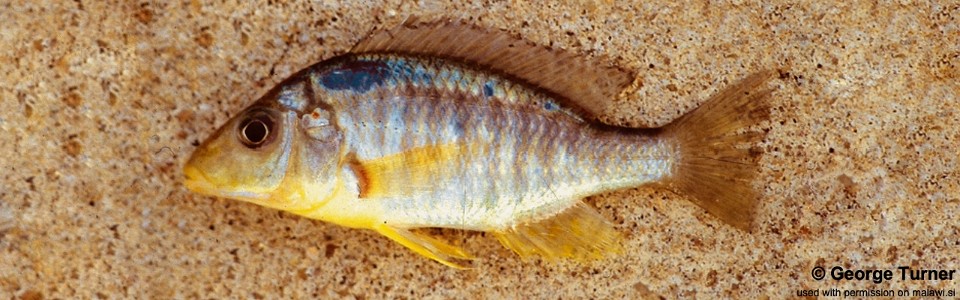
Both sexes show yellow coloration on the snout and lower part of the head.
Recommended aquarium size:
At least 450 L (minimum tank length 150 cm)
Aquarium setup:
Fine sand substrate is essential to allow natural feeding and breeding behavior.
Provide wide open sandy areas with minimal rockwork.
Ensure sufficient space for the establishment of temporary breeding territories.
Diet:
Carnivorous predator. Feeds mainly on insects and small crustaceans located in the sand
using the well-developed cephalic sensory system characteristic of the genus.
Breeding:
Maternal mouthbrooder. Spawning is believed to take place in temporarily defended territories.
Breeding males in nuptial coloration are most frequently observed in late spring and early summer.
Aggression:
Low to moderate. Generally peaceful, with limited aggression related to temporary breeding activity.
Special notes:
A distinctive sand-dwelling Aulonocara characterized by a yellow snout, relatively large size,
and a longer snout compared to A. nyassae.
It differs from A. rostratum by its shorter snout and smaller eye.
Although officially listed as Least Concern, many populations are believed to have declined severely
due to overfishing with beach seines, making the species rare in the wild today.
Some populations may attain slightly larger average sizes, but no clear color differences are known.






Provide wide open sandy areas with minimal rockwork.
Ensure sufficient space for the establishment of temporary breeding territories.
It differs from A. rostratum by its shorter snout and smaller eye.
Although officially listed as Least Concern, many populations are believed to have declined severely due to overfishing with beach seines, making the species rare in the wild today.
Some populations may attain slightly larger average sizes, but no clear color differences are known.
Photo gallery