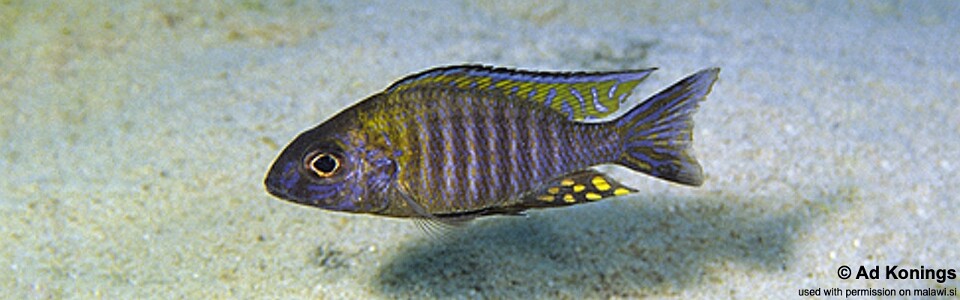
Aulonocara sp. 'chitande type north' Mala (Mara) Point
Genus:
Aulonocara
Biotope:
Intermediate habitat. Depending on locality, breeding males may be found over open sand or
closer to rocks. Females typically gather in groups and forage on sandy areas.
Geographic distribution:
Northern Lake Malawi. Occurs around Likoma Island and Chizumulu Island, along the northwestern
shoreline between the South Rukuru River and Nkhata Bay, and along the Mozambique coast near
Mala (Mara) Point.
Typical adult size:
Males up to about 10 cm, females up to about 8 cm.
Sexual dimorphism:
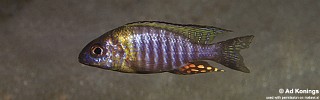
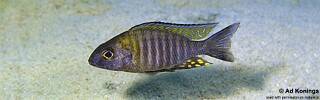
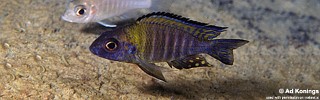
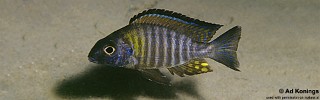
Strong. Males display a distinctive black marginal band in the dorsal fin,
a feature unique among Aulonocara.
Females resemble those of other Chitande Type forms and are difficult to distinguish.
Recommended aquarium size:
300 L (minimum tank length 125 cm)
Aquarium setup:
Fine sand substrate with a few scattered rocks.
Provide open sandy areas for foraging females and limited rock structures
where males can establish territories.
Diet:
Small invertebrates living in the sand, located using the enlarged sensory pores on the head.
Feeding behavior involves hovering motionless just above the substrate and detecting prey
movements.
Breeding:
Maternal mouthbrooder. Males defend shallow depressions in the sand as spawning territories,
usually near rocks. On the northwestern coast, males may also defend caves at greater depths.
Females forage a few meters away and visit male territories when ready to spawn.
Breeding males continue to feed and can be found throughout the year.
Aggression:
Low to moderate. Territorial behavior is mainly directed toward conspecific males.
Special notes:
An undescribed member of the “Chitande Type” Aulonocara complex.
The black dorsal-fin margin of breeding males is unique within the genus and allows
reliable identification.
Not evaluated by the IUCN. There are currently no indications that this form is threatened.
Populations across most of its range show very similar male breeding coloration,
although males from Nkhata Bay are reported to have an especially bright orange head.




Not evaluated by the IUCN. There are currently no indications that this form is threatened.
Populations across most of its range show very similar male breeding coloration, although males from Nkhata Bay are reported to have an especially bright orange head.
Photo gallery