Open water habitat.
Occurs mainly above sandy bottoms and occasionally over rocks.
Typically found at depths between 3 and 15 m.
Geographic distribution:
Lake-wide distribution throughout Lake Malawi.
Typical adult size:
Males up to about 35–40 cm total length.
Females up to about 25–30 cm.
Sexual dimorphism:
Males grow significantly larger than females.
In large males, the soft-rayed portions of the dorsal and anal fins become elongated.
Recommended aquarium size:
At least 1000 L.
Aquarium setup:
Minimum tank length around 250 cm.
Provide extensive open swimming space with minimal obstructions.
Substrate should be sandy; rockwork should be limited and placed peripherally.
Keep one male with two females.
Groups with multiple males are not recommended.
Tankmates must be very large haplochromines or other large predators;
smaller fish will be considered prey.
Diet:
Carnivorous predator.
Specialized pursuit hunter feeding primarily on Lake Malawi sardines
(Engraulicypris sardella, “usipa”).
In aquarium, requires large meaty foods appropriate for piscivores.
Breeding:
Maternal mouthbrooder.
Territorial males construct large bowers in sandy or muddy substrates
(approximately 100 cm in diameter and 10–20 cm deep).
Females are attracted from open water to spawn.
Fry are guarded by the female for several weeks after release.
Juveniles form small schools in shallow water until reaching about 15 cm.
Aggression:
Relatively peaceful toward sufficiently large species.
Strongly predatory toward smaller fish, which will be eaten.
Males are highly territorial toward conspecific males.
Special notes:
Distinguished from Champsochromis spilorhynchus by a more slender body
and a faint pre-orbital (tear) stripe.
Often follows large schools of usipa in open water.
Assessed as Least Concern (LC) on the IUCN Red List.
Rarely caught in beach seines despite inhabiting shallow sandy areas.


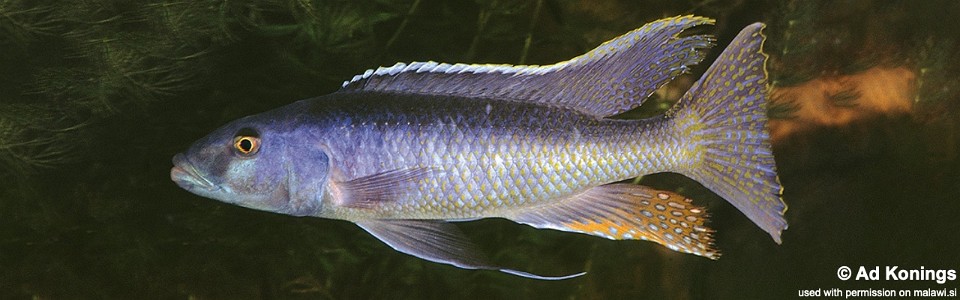




Photo gallery