Open water close to shore and intermediate habitats above sandy–rocky substrates.
Occurs at depths between 7 and 15 meters.
Geographic distribution:
Lake Malawi, between Eccles (Chimwalani) Reef and Gome.
Typical adult size:
Males up to about 14 cm, females up to about 11 cm.
Sexual dimorphism:
Males have a dark blue body with a bright white dorsal fin margin; anal and caudal fins
show yellow coloration. Females and juveniles are silvery-yellow with three black lateral spots.
Recommended aquarium size:
At least 400 liters; minimum aquarium length of 140 cm recommended.
Aquarium setup:
Spacious aquarium with large open swimming areas and fine sandy substrate.
Scattered larger stones should be present but kept low to preserve swimming space.
Best kept with one male and 2–3 females, or in larger groups with multiple males
provided each male has 2–3 females.
Diet:
Carnivorous. Feeds mainly on phyto- and zooplankton in open water; also consumes
small invertebrates and microorganisms when plankton is scarce.
Breeding:
Maternal mouthbrooder. During breeding, males move to rocky areas where they defend
the top of a rock or a cave. Females brood eggs for approximately 21 days and produce
broods of about 25–35 fry.
Aggression:
Mildly aggressive within the species, otherwise a peaceful cichlid.
Special notes:
Belongs to the Copadichromis mbenjii group. Females cannot be reliably distinguished
from those of Copadichromis trewavasae. Should not be kept with closely resembling
species due to hybridization risk.

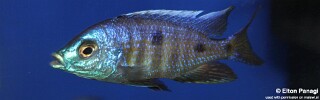


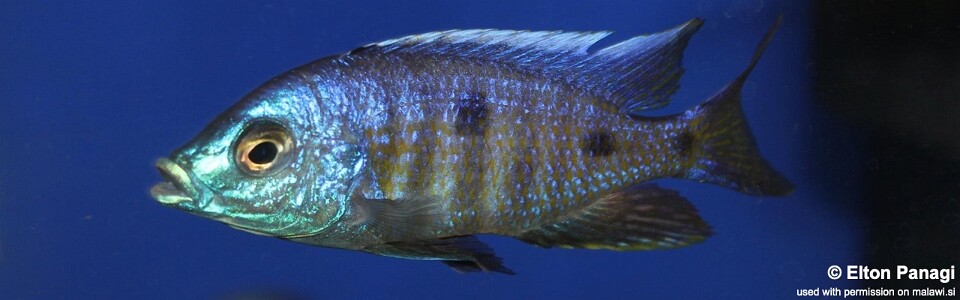




Photo gallery