Deep-water habitat near the lake bottom; the type series was taken by trawl at
73 m over mud substrate, indicating an affinity for benthic deep-water
environments.
Geographic distribution:
Confirmed only from the southeastern arm of Lake Malawi, based on the single
1985 trawl collection off Thumbi East Island near Monkey Bay; additional reports
linked to the “blackfin” phenotype have been suggested from other areas but are
not confirmed.
Typical adult size:
Up to 119.7 mm standard length (about 15 cm total length).
Sexual dimorphism:
In preserved material, males are darker overall, with a darkened snout and dorsal
flank fading ventrally; pelvic fins are black and the distal membranes of the anal
fin are dark grey to black. Females show a similar pattern but are paler overall.
Egg spots on the anal fin are absent in males.
Diet:
CT scans found the stomachs of the type series empty; based on exposed oral teeth
and unicuspid teeth in the pharyngeal jaws, the species has been suggested to be
piscivorous.
Breeding:
Species-specific breeding observations are lacking due to the deep-water capture
context; the species is treated as a maternal mouthbrooder consistent with the
genus. Material interpreted as reproductively active indicates a dark breeding
pattern, including dark pelvic and anal fins, dark dorsal lappets, and a distinct
dark patch in the central caudal fin; males are notable for the apparent absence
of anal-fin egg spots.
Special notes:
The type series (eight specimens) was collected together in a single trawl haul
off Thumbi East Island near Monkey Bay at 73 m, and was initially identified
as Diplotaxodon argenteus because the oral teeth remain exposed even when
the mouth is closed. The species is distinguished from D. argenteus by a
shorter snout and a more elongate, fine-headed appearance, and it has higher
reported gill-raker counts (23–27). The outer-row lower-jaw teeth are widely
spaced and exposed, contrasting with the closely packed condition described for
D. limnothrissa. The species has been linked to breeding males previously
referred to as Diplotaxodon sp. ‘blackfin’.
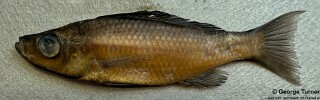

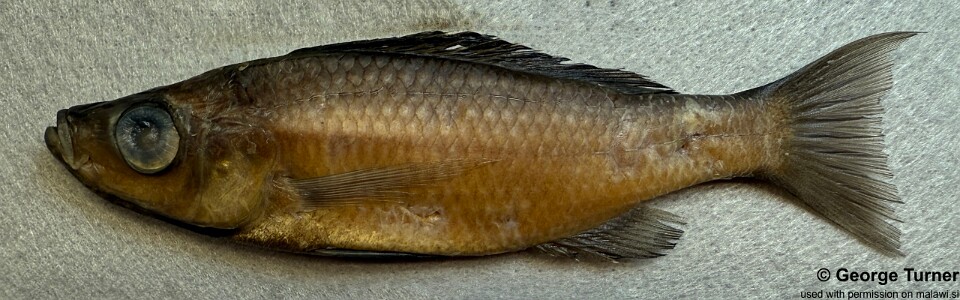




Photo gallery