Shallow habitats between about 3–25 m depth, typically over sandy
bottoms where males build bowers; breeding arenas may be very dense.
Geographic distribution:
Lake-wide distribution is reported, representing the common
Mchenga often referred to as M. eucinostomus; also
recorded sympatric with M. cyclicos at Masasa Reef.
Typical adult size:
Up to about 14 cm total length.
Sexual dimorphism:
Females and non-breeding males are silvery and bear yellow ocelli in the
anal fin. Juveniles and females have hyaline fins. Breeding males lack
black caudal-fin markings.
Breeding:
Males defend small spawning sites on sand and construct bowers in large
arenas. Territorial males are present throughout the year, with seasonal
peaks of reproductive activity. Females may assemble in large schools a
few meters above the bottom.
Special notes:
Distinguished from M. conophoros, M. inornata, and
M. cyclicos by yellow anal-fin ocelli in females and non-breeding
males. Breeding males lack the black caudal-fin markings reported for
breeding males of M. cyclicos and M. conophoros.


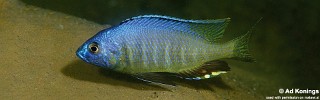
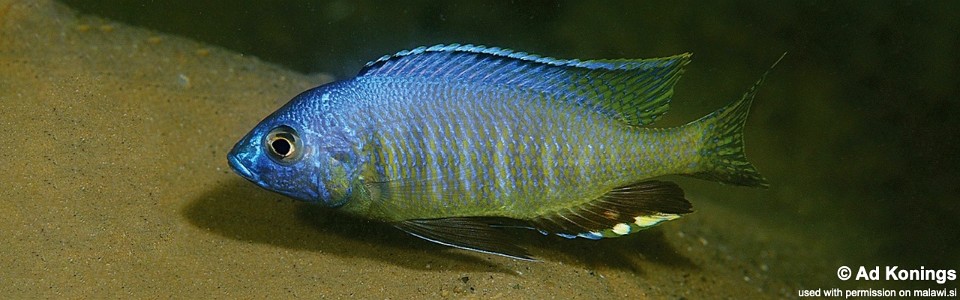




Photo gallery