Sand-dwelling species occurring along sandy coasts, commonly below
10 m depth.
Geographic distribution:
Endemic to Lake Malawi, widespread in the southern and western parts
of the lake in Malawi; also reported from Chilola Bay in Mozambique.
Typical adult size:
Males up to 23 cm total length; females up to 15 cm total
length.
Sexual dimorphism:
Dominant males are solid blue, sometimes with a small yellow spot on
each scale; breeding males may lose the diagonal stripe and show
prominent dark vertical bars. Females are silvery with a diagonal
band and yellow caudal fin.
Recommended aquarium size:
An aquarium volume of 600 L is recommended.
Aquarium setup:
Provide a large sandy area with as much open sand as possible,
interrupted by a few larger stones. Keep one male with several
females.
Diet:
Primarily molluscivorous; morphology indicates a pharyngeal crusher
of snails with large molariform teeth. Stomach contents examined
contained mainly gastropod remains and shell fragments, as well
as sand, detritus, algal remains, copepods, chironomids, and other
arthropod material.
Breeding:
Territorial males construct sandcastle bowers on open sand and defend
them while attracting females. Breeding males are completely blue
and display vertical flank bars.
Aggression:
Generally peaceful and best kept with other calm species.
Special notes:
A deep-bodied species with oblique striping, characterized by a small,
rounded head and small mouth. It differs from Tramitichromis brevis
by a relatively smaller eye, and from M. sphaerodon by a shorter,
more rounded snout.


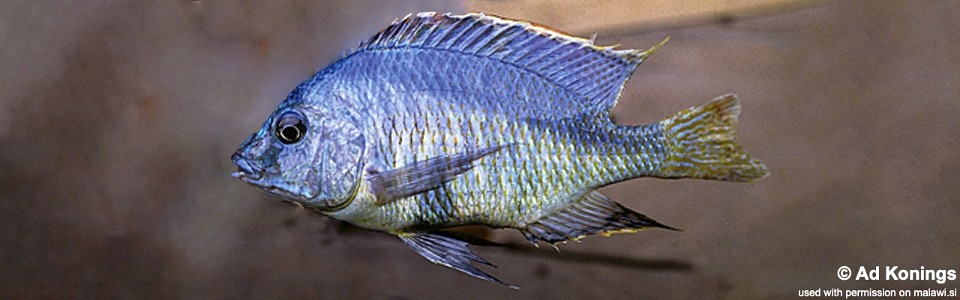




Photo gallery