Sandy and intermediate habitats over sand, typically at depths
of 7–15 m.
Geographic distribution:
Lake-wide in Lake Malawi and among the most common non-mbuna
in intermediate habitats of sand/mud with rocks.
Typical adult size:
Males around 17–18 cm total length; females usually smaller,
commonly up to about 14 cm.
Sexual dimorphism:
Females are silvery with a diagonal series of large black
blotches on the upper flank; males are blue with a greenish
sheen on snout and cheek, with vertical bars becoming more
prominent before full coloration. Northern females and
non-breeding males may show yellow-orange anal and ventral
fins, while southern populations have hyaline fins.
Recommended aquarium size:
An aquarium volume of 500 L is recommended.
Aquarium setup:
Provide extensive sand with a few larger stones interrupting
open areas. Stock as 1 male with 2–3 females, or keep in a
larger group such as 3 males with 7 females.
Diet:
Carnivorous, feeding mainly on invertebrates such as insect
larvae and small crustaceans, with hard-shelled prey implied
by the large molariform pharyngeal teeth.
Breeding:
Breeding males become territorial and defend a cleared
spawning patch in the intermediate habitat rather than
constructing a bower. Spawning is reported across much of the
year, with mouthbrooding lasting about three weeks before fry
are released.
Aggression:
A peaceful cichlid best kept with other calm species; due to
its size it can also be housed with larger, mild predators.
Special notes:
Diagnosed by a diagonal line made of large blotches that do
not form a continuous stripe; this separates it from
M. sphaerodon, where the diagonal line is typically thin,
often solid, and positioned on the upper lateral line.
The diagonal pattern in M. mola runs below the upper
lateral line on the posterior half of the body. It is also
separated from M. ericotaenia by the greatly enlarged,
molar-shaped lower pharyngeal teeth with a spherical crown.


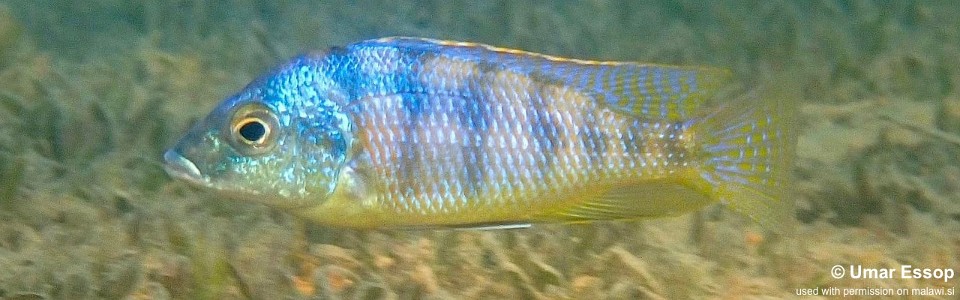




Photo gallery