Intermediate habitat; recorded at depths of 3–15 m.
Geographic distribution:
Western coast of Lake Malawi at Nkhata Bay, Lion’s Cove,
Ruarwe, and Hora Mhango.
Typical adult size:
Up to 16–18 cm total length.
Sexual dimorphism:
Males are larger and more colorful. Females remain silvery with shorter
fins; dominated or non-breeding males can resemble females but are usually
larger.
Recommended aquarium size:
A minimum aquarium volume of 400 L is recommended, preferably more
than 600 L.
Aquarium setup:
Maintain alkaline, moderately hard water with regular water changes and
filter cleaning.
Diet:
Primarily bottom-dwelling invertebrates and other soft-bodied
invertebrates sifted from sand by pushing the snout into the substrate.
Breeding:
Maternal mouth-brooder. Breeds year-round, mainly from August to January.
Territorial males dig shallow bowls or small semicircular sand-scrape pits
against rocks and court females around the site. Eggs are collected in the
female’s mouth and fertilized during spawning; incubation lasts about three
weeks, and fry are released over the following week.
Females guard the young after their initial release.
Aggression:
Generally not aggressive among Malawi haplochromines and is usually not
dominant in a Malawi aquarium.
Special notes:
Displays the genus-typical dark diagonal band on the flanks, which may be
blotchy or complete from the nape to the caudal peduncle. Compared to
Mylochromis sp. 'lateristriga makanjila', this form has a relatively
shorter snout. It occurs sympatrically with related diagonal-striped
species in the intermediate habitat of the western coast.
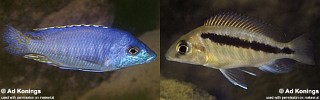
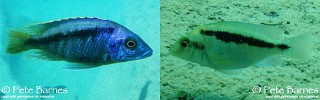
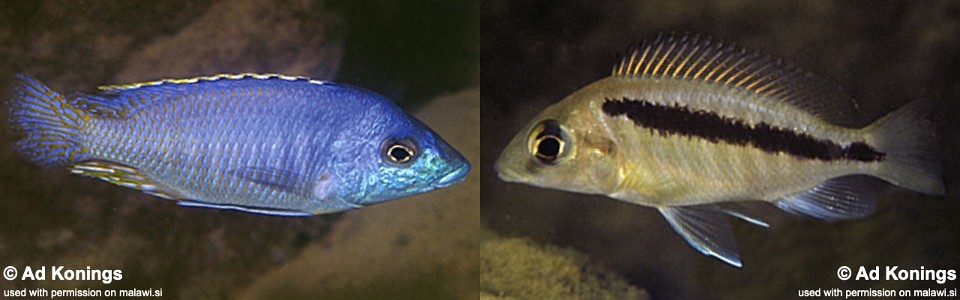




Photo gallery