
Shallow vegetated areas and sandy zones, also occurring in
rock-sand intermediate habitats, usually within
10–15 m depth.
Geographic distribution:
Southern end of Lake Malawi, from Kande Island to Mangochi
along the western shore and from Metangula (Mozambique) to
Mangochi along the eastern shore; also recorded from Lake
Malombe.
Typical adult size:
Up to 25 cm total length or more in aquarium.
Sexual dimorphism:
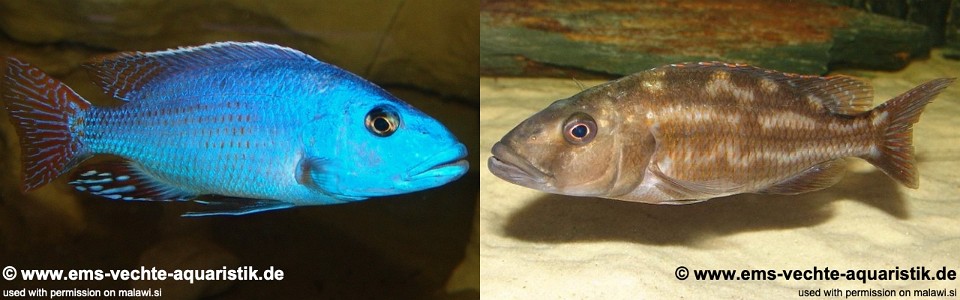
Sexually mature males are solid sky blue on head, flank, and
dorsal fin. Adult females range from silvery yellow-orange to
dark brown, with the basic melanin pattern usually visible.
Recommended aquarium size:
An aquarium volume of at least 750 L is recommended for a
single-species group with one male and several females. For a
community aquarium with several large species, an aquarium
volume of at least 1000 L is recommended.
Aquarium setup:
Keep with similarly sized fishes and avoid small mbuna,
Aulonocara, or other potential prey. Provide a hiding or spawning
site for each species, such as caves formed by rock piles or
stacked pipes, with spaces large enough for a pair to spawn.
Diet:
Piscivorous predator of mbuna and other small fishes, snapping
up prey with a large mouth. In captivity it may be fed mussels and
large crustaceans, and also accepts pieces of fish.
Breeding:
Maternal mouth-brooder; eggs are fertilized inside the
female’s mouth. Males hold territories only during the breeding
season, and in the lake breeding males may defend an area without
a clearly visible spawning site. Mouthbrooding females have been
observed solitary and cruising the habitat. In captivity, fry are
released after about three weeks and may be taken back into the
female’s mouth for five to six weeks after release.
Aggression:
Predatory and potentially dominant in community aquaria;
avoid keeping more than one male in the same tank.
Special notes:
Assigned to Nimbochromis but noted as strongly
resembling Tyrannochromis nigriventer. Distinguished by
broad, irregular longitudinal bands and the absence of spots on
the pectoral fins except in comparison with N. venustus.
Photo gallery