Occurs in intermediate, vegetated, muddy and rocky
habitats, most frequently in sheltered bays with muddy bottoms.
Also recorded from pure rocky areas and from depths exceeding
50 m.
Geographic distribution:
Lake-wide distribution in Lake Malawi, more frequently
encountered in the southern half of the lake.
Typical adult size:
Males up to about 19 cm total length in the wild;
females slightly smaller. In aquaria males may exceed
25 cm.
Sexual dimorphism:
During the breeding period males become entirely blue and
the blotched body pattern is obscured. Outside the breeding
season males and females are very similar in appearance.
Recommended aquarium size:
An aquarium volume of at least 1000 L is recommended for
a community tank with several large species, while a species tank
with one male and several females should contain about
750 L.
Aquarium setup:
House with similarly sized cichlids and avoid small species
that may be regarded as prey. Keep only one adult male per tank.
Provide rocky structures and spawning sites such as shallow pits
beside rocks or cave-like spaces formed by piled rocks or pipes.
Diet:
Piscivorous ambush predator using a specialized
side-lying technique. It settles motionless on mud, sand or rock,
partially burying itself or stirring sediment to camouflage its
outline. Small cichlids approach the pale body and are captured
with a rapid sideways strike. Adults maintain individual feeding
territories along stretches of shoreline.
Breeding:
Maternal mouth-brooder. Males defend shallow
saucer-shaped spawning sites beside large rocks, sometimes forming
small leks. Eggs are fertilized on the substrate before being
taken into the female’s mouth. Mouthbrooding females remain
solitary and guard free-swimming fry for several weeks after
release.
Aggression:
Large predatory species that can dominate smaller
haplochromines; males defend territories during the breeding
period.
Special notes:
Known locally as “kaligono” (“sleeper”) because of its
characteristic side-lying ambush posture. Distinguished by a
highly contrasting blotched pattern and four dark bars radiating
from the eye, as well as faint spots on the pectoral fins.


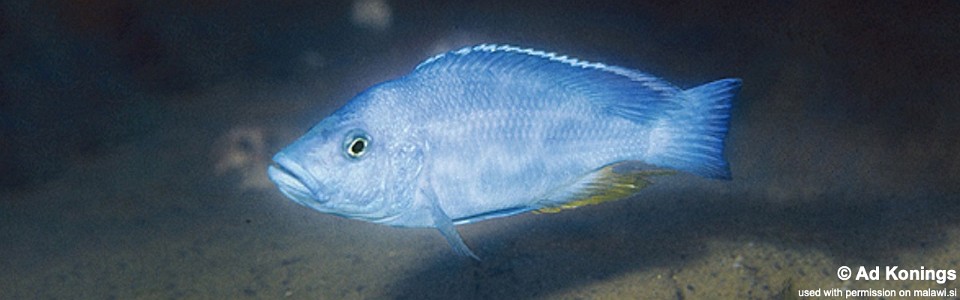




Photo gallery