Most common in intermediate and vegetated habitats,
but also encountered in rocky areas. Hunting groups may roam
through various habitat types.
Geographic distribution:
Occurs throughout Lake Malawi. No distinct geographic
variants are recognized.
Typical adult size:
Males slightly over 26 cm total length in the wild;
females up to about 18 cm. In aquaria males may reach
approximately 30 cm total length.
Sexual dimorphism:
Territorial males become entirely blue and the spotted
pattern is obscured. The dorsal fin shows red-orange lappets and a
pale submarginal band, and the anal fin has a yellow to orange
distal border. Females and non-territorial males are white or
yellow with numerous dark brown spots and speckles arranged partly
in rows on the fins.
Recommended aquarium size:
An aquarium volume of at least 1000 L is recommended for
a community tank with several large species, while a species tank
with one male and several females should contain about
750 L.
Aquarium setup:
Keep with similarly sized cichlids and avoid small species
that may be preyed upon. Maintain only one adult male per tank.
Provide rocky structures and spawning sites such as shallow pits
beside large rocks or cave-like spaces formed by piled rocks or
pipes.
Diet:
Piscivorous predator. Often forms hunting groups of 20 to
500 subadult or adult individuals that move through the habitat
capturing small fishes. When solitary it may remain motionless on
the sand as an ambush predator, but unlike
N. livingstonii it does not lie on its side.
Breeding:
Maternal mouth-brooder. Males dig large shallow
saucer-shaped spawning pits beside rocks, sometimes forming a
cave-crater bower. Eggs are fertilized on the substrate before
being taken into the female’s mouth. After first release the fry
are taken back into the mouth for at least four weeks. Breeding
males do not feed during the breeding period and defend
territories mainly against conspecifics.
Aggression:
Large predatory species that can dominate smaller
haplochromines; males defend territories during breeding.
Special notes:
Distinguished from other congeners by dark spots on the
pectoral fins and by the absence of four dark bars radiating from
the eye. Considerable morphological variability has been recorded,
including variation in body depth, eye diameter, snout length and
lower jaw proportions.


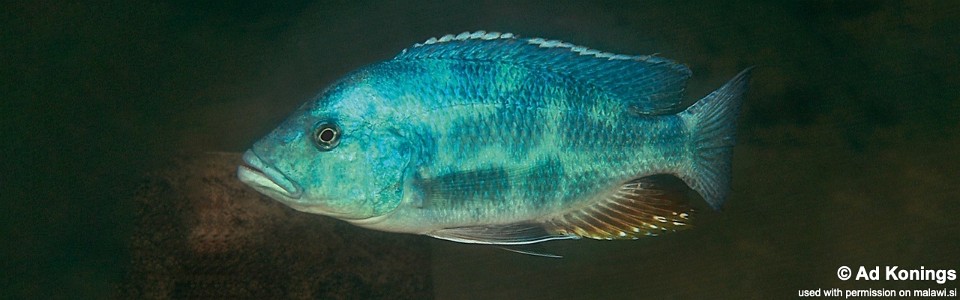




Photo gallery