Primarily associated with sandy substrates, most often at
depths of 10–20 m, but recorded as deep as 42 m. Juveniles
occur in shallow rocky areas and individuals may also be found
among macrophyte beds in shallow water.
Geographic distribution:
Endemic to Lake Malawi, most frequently encountered in
the southern part of the lake. Along the western shore it occurs
from Kande Island to Mangochi and along the eastern shore from
Makanjila Point to the Shire River, including islands except
Chinyankwazi and Chinyamwezi.
Typical adult size:
At least 23 cm total length.
Recommended aquarium size:
An aquarium volume of 1000 L is recommended.
Diet:
Ambush predator feeding on small fishes and
invertebrates. It remains motionless after partially burying itself
in sand, waiting for prey to approach. Unlike
N. livingstonii, it does not lie on its side. The yellow
coloration may attract juvenile cichlids.
Breeding:
Breeding occurs on sandy substrates.
Special notes:
Distinguished by the absence of dark spots on the
pectoral fin rays and by blotches forming regular vertically
elongated lozenges. Breeding males display bright green and yellow
coloration. Known locally as “kaligono” (“sleeper”) because of its
ambush-hunting behavior.


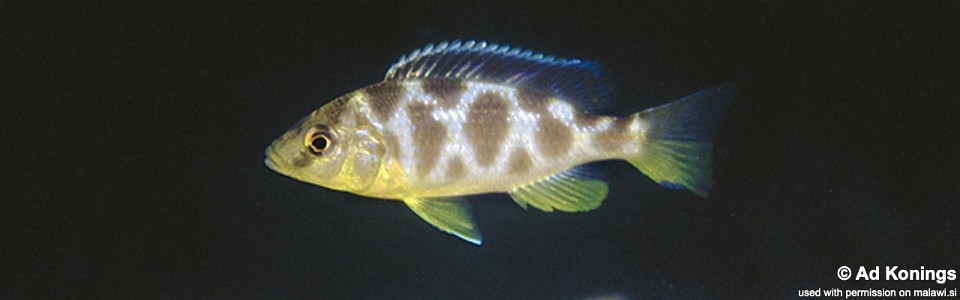




Photo gallery