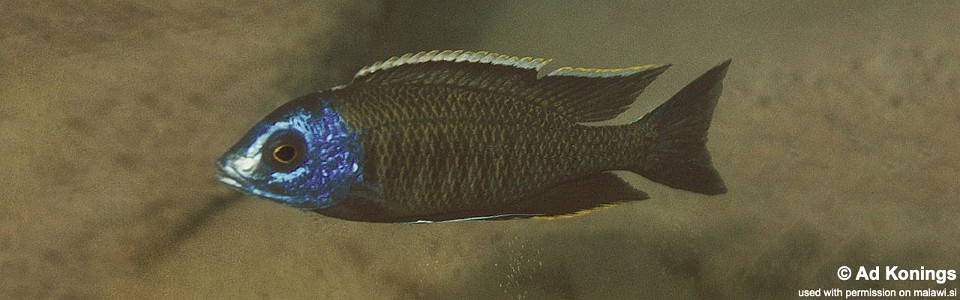

Sandy habitats in the southern part of Lake Malawi.
Females occur in schools in open water. The species has been
observed to depths of 16 m, and breeding males were recorded
at 22 m at Nkhomo Reef.
Geographic distribution:
Endemic to Lake Malawi. Known from the southern end of
the lake, including Nkhomo Reef near Benga and probably Domwe
Island.
Typical adult size:
Up to 16 cm total length.
Recommended aquarium size:
A minimum tank length of 130 cm and a volume of
400 l are recommended.
Aquarium setup:
An aquarium with open sandy areas is appropriate.
Spawning behavior involves excavation beside a small to
medium-sized rock, forming a cave-like crater under or against
the rock.
Diet:
Feeds on plankton, mainly phytoplankton. The gut is
long and coiled, exceeding three times the standard length, and
examined specimens contained algal remains.
Breeding:
Breeding occurs from August to December. Males
construct a semicircular cave-crater beside or beneath a rock,
leading females from mid-water to the spawning site. Spawning
takes place under the partly excavated rock.
Aggression:
Territorial during the breeding season, with males
defending the constructed spawning site.
Special notes:
Characterized by a well-developed mid-lateral stripe,
a relatively shallow body (about one third of standard length),
and 14–15 gill rakers. The caudal fin is crescentically
emarginate. Evaluated as Critically Endangered (CR) due to its
extremely restricted range and absence of confirmed records
since 1997, with an estimated area of occupancy of 4 km2.
Photo gallery