Sediment-rich transition zones adjacent to rocky shorelines,
often in deeper water; spawning may take place on sand
or between rocks depending on locality.
Geographic distribution:
Lake Malawi; reported from throughout the lake.
Typical adult size:
Up to about 17 cm in males and around 14 cm in females.
Sexual dimorphism:
Males are light metallic blue shading into yellow and show
a black stripe across the eye; three dark flank spots
may be visible. Females and juveniles are silvery
sand-coloured with three black spots.
Recommended aquarium size:
A minimum tank length of 130 cm and a volume of 350 l
are recommended.
Aquarium setup:
Spacious aquarium with open swimming areas, several rock
structures and shelters; fine sand mixed with some
coarser substrate is suitable. Best maintained with
a single male and several females.
Diet:
Omnivorous; feeds on edible material stirred up from
bottom sediments.
Breeding:
Mouthbrooder; incubation lasts about 21 days. Spawning
behaviour varies by locality and may occur on sand
or between rocks. Females often remain among rocks
until fry are fully developed.
Aggression:
Males defend territories during breeding.
Special notes:
Originally described by Trewavas (1935) as Haplochromis heterodon.
Distinguished from Otopharynx sp. ‘heterodon likoma’,
which constructs bowers, whereas O. heterodon does not.
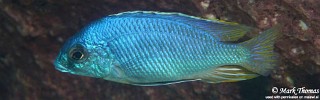

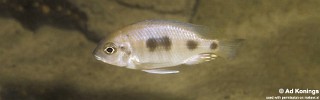
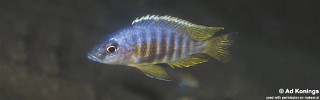
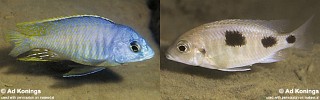
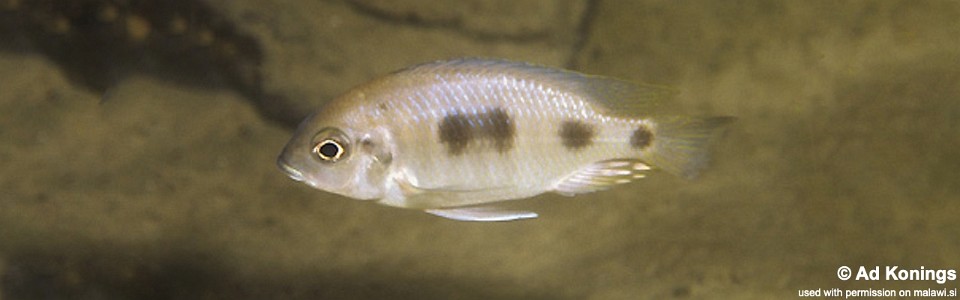




Photo gallery