Rocky shores and the transition zone between rock and
stone habitats, from near the surface to at least
20 m; territorial males occupy caves and defend
small areas, recorded down to about 30 m.
Geographic distribution:
Southern Lake Malawi around Cape Maclear and the
Nankhumba Peninsula, including islands such as
Maleri, Mumbo, Thumbi West, Zimbawe Rock,
Domwe, Thumbi East, Chinyankwazi and
Chinyamwezi.
Typical adult size:
Males up to about 100 mm standard length in the wild,
reaching in aquarium approximately 14–17 cm total length;
females smaller, about 8–10 cm.
Sexual dimorphism:
Adult males metallic blue with a white to orange blaze
along the top of the head extending into the dorsal
fin margin and sometimes the upper caudal margin;
anal fin with orange margin but lacking eggspots.
Females tan to brown with darker flank spots.
Recommended aquarium size:
A minimum tank length of 130 cm and a volume of
350 l are recommended.
Aquarium setup:
Rocky aquascape with caves for territorial males and
multiple shelters for females; regular partial
water changes are recommended. Best maintained
as one male with 2–4 females.
Diet:
Feeds predominantly on planktonic crustaceans,
especially diaptomid copepods; gut length about
150% of standard length. Also observed feeding
on fish feces.
Breeding:
Mouthbrooder; females incubate eggs and fry for about
20 days. Spawning occurs on rock surfaces, with
females collecting eggs in the mouth immediately
after deposition. Males defend small territories
associated with caves.
Aggression:
Males defend territories against conspecific males.
Special notes:
The Maleri Islands population was formerly described as
Otopharynx walteri. Subsequent morphometric analyses demonstrated that it cannot be
distinguished from Otopharynx lithobates, and because the name O. lithobates was published
earlier it has nomenclatural priority; O. walteri is therefore treated as its junior synonym. Males
exhibit geographic variation in the coloration of the frontal blaze and dorsal fin margin, ranging
from pure white to bright orange; the well-known orange-blazed aquarium form is reported to
originate from Zimbawe Rock. On tanganyika.si, the population formerly known as O. walteri is
referred to as Otopharynx cf. lithobates.
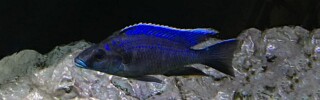
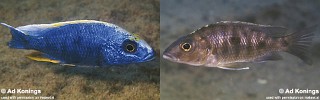
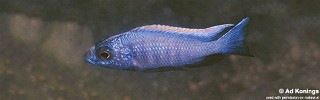
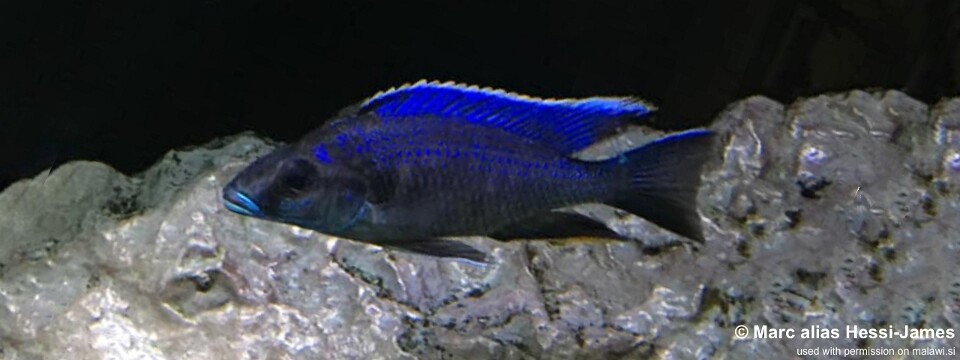




Photo gallery