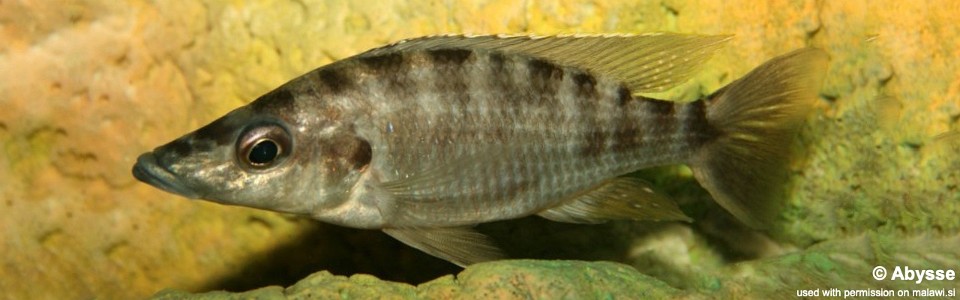

Deep-water habitat, trawled from 74–147 m and presumed
to occur over sandy bottoms. A living specimen was
also collected by scuba-divers in shallower water
near rocky or intermediate habitats.
Geographic distribution:
Recorded from southern Malawi (Domira Bay, Senga Bay and
the SW–SE transect north of the Nankumba
Peninsula) and from the northern lake (Young’s
Bay, Malawi; Wissman Bay, Tanzania). Also
reported from the northern part of the SE Arm.
Typical adult size:
Reported maximum size about 13 cm TL.
Sexual dimorphism:
Males show slight coloration, particularly in the dorsal
fin. Males are suggested to reach larger size than
females and to develop longer fins.
Recommended aquarium size:
An aquarium volume of 300–400 l may be suitable if the
species becomes available.
Aquarium setup:
In captivity the species was
described as adaptable and able to live in various
community-tank configurations.
Diet:
Wild diet is not documented. In captivity it readily
accepts a wide range of standard aquarium foods.
Breeding:
Breeding has not been documented; it is regarded as a
maternal mouthbrooder.
Aggression:
The observed aquarium male was often dominant in a
community tank, with a moderate aggression level.
Special notes:
Distinguished by a very wide, horizontally flattened snout
and a very elongate body. Only a
single live specimen is specifically reported from
the aquarium trade, arriving in an import from
Membe Point (Likoma) in February 2004.
Photo gallery