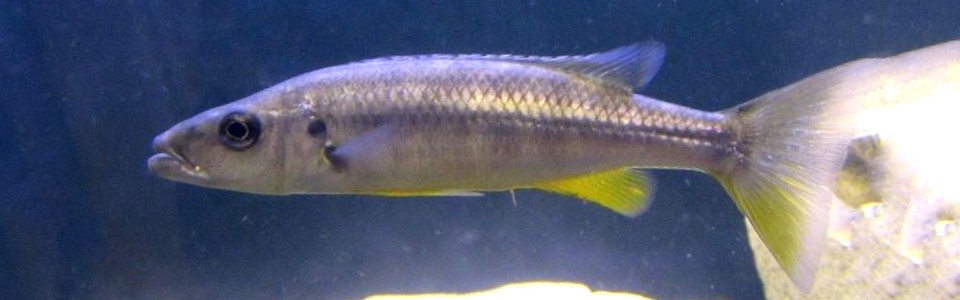

A small, shallow muddy lake fringed by extensive macrophyte beds; the species
occurs throughout the open water of the lake.
Geographic distribution:
Endemic to Lake Chilingali (Malawi), an inland satellite lake of Lake Malawi
near Nkhotakota.
Typical adult size:
About 9–10 cm standard length (11–12 cm total length) in nature;
in aquaria at least 11 cm standard length
(14 cm total length).
Sexual dimorphism:
Breeding males develop orange pelvic and anal fins, with orange extending
onto the lower caudal fin, chest and branchiostegal membrane; during
courtship orange may extend further onto caudal and dorsal fins.
Females remain silvery.
Aquarium setup:
Open aquarium with strong current preferred; plants are ignored.
Non-breeding fish shoal in mid-water, while breeding males may
become territorial and harass females.
Diet:
Feeds mainly from the water column. Wild stomach contents included
Chaoborus larvae and pupae and some cladoceran
zooplankton.
Breeding:
Maternal mouthbrooder. In captivity, spawning occurs in open water,
with eggs released singly and collected mid-water by the female.
Females do not guard free-swimming fry.
Aggression:
Generally active and shoaling, but breeding males can become highly
excitable and aggressive toward females and rival males.
Special notes:
Undescribed species and the only Rhamphochromis recorded
from Lake Chilingali. It resembles R. longiceps in small,
closely spaced teeth and early maturation, but remains much
smaller and lacks anal-fin eggspots in breeding males.
Has served as a model pelagic predatory cichlid in laboratory
research, with captive populations maintained at several UK
universities and at Chester Zoo, and features in numerous
scientific publications.
Recent surveys failed to locate surviving wild populations,
and the species may no longer persist in its native lake.
Has served as a model pelagic predatory cichlid in laboratory research, with captive populations maintained at several UK universities and at Chester Zoo, and features in numerous scientific publications.
Recent surveys failed to locate surviving wild populations, and the species may no longer persist in its native lake.
Photo gallery