Occurs in the southern part of Lake Malawi within the transition zone, moving among rock
formations and over adjacent sandy areas.
Geographic distribution:
Recorded from the southern half of Lake Malawi and considered rare, with only isolated
observations at single localities.
Typical adult size:
Males reach approximately 20 cm total length. Females remain smaller at about
15–17 cm.
Sexual dimorphism:
Males are larger and display breeding coloration, while females remain smaller.
Recommended aquarium size:
A minimum aquarium volume of 800 l with a tank length of at least 170 cm is recommended.
Aquarium setup:
The transition zone habitat should be recreated with large rock formations providing visual
barriers, crevices and shelters, combined with open sand areas. Aquarium depth should not be
less than 60 cm. Moderate lighting is advisable in accordance with its natural depth range
of about 10–25 m.
Diet:
Carnivorous and piscivorous, preying on mbuna and their juveniles in the lake. In aquaria it
accepts high-protein foods including live or frozen items such as mosquito larvae, amphipods,
mysis and Artemia.
Breeding:
Maternal mouthbrooder. Harem maintenance is recommended, for example one male with two to
three females. Group maintenance with multiple males is possible only in very large aquaria.
Aggression:
Predatory and assertive but not described as extremely aggressive. It should not be combined
with very dominant species, and small mbuna may be regarded as prey.
Special notes:
Considered rare in the hobby. Morphologically it resembles Sciaenochromis fryeri but is
generally described as larger and deeper-bodied. It has been observed hunting juvenile cichlids
by rapidly lunging forward once prey is detected.
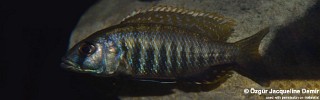
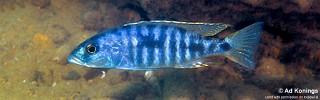
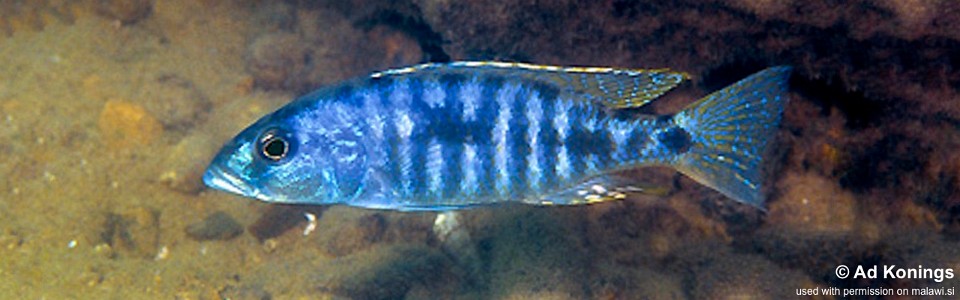




Photo gallery