Sandy zones and transition habitats, often encountered over open sand at depths of about
25–50 m.
Geographic distribution:
Recorded from the southeastern arm of Lake Malawi and localities including Domwe Island,
Mumbo Island and Nkhata Bay. It has also been collected in Tanzanian waters, including
Mbamba Bay.
Typical adult size:
Males reach up to about 16 cm total length, while females attain about 14 cm.
Sexual dimorphism:
Males grow larger than females, and ripe males are described as showing prominent dark
vertical bars.
Recommended aquarium size:
For group maintenance, an aquarium volume of at least 1500 l is recommended; otherwise,
a minimum volume of 600 l with a tank length of at least 180 cm can be used.
Aquarium setup:
A sandy or lightly structured transition layout is suitable. Provide visual barriers and
shaded retreat zones to reduce stress, with scattered large stones that can function as
territorial boundaries. Plants may be included in sand-zone style setups.
Diet:
Carnivorous, feeding on juvenile fishes, small invertebrates and other small fishes. In
aquaria, offer protein-rich foods and frozen items; fresh shrimp may also be used.
Aggression:
Can be strongly assertive, with intraspecific aggression particularly noted in group
settings. Fish smaller than about 5 cm may be taken as prey.
Special notes:
Reported by Turner (1996) as a small Stigmatochromis resembling Stigmatochromis woodi and
later described as Stigmatochromis macrorhynchos. Some specimens have been exported.


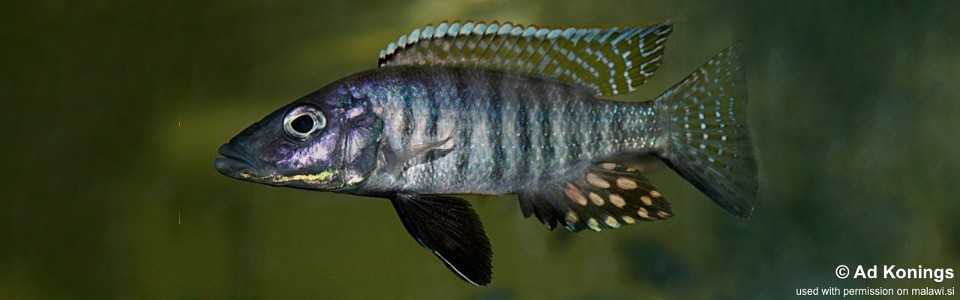




Photo gallery