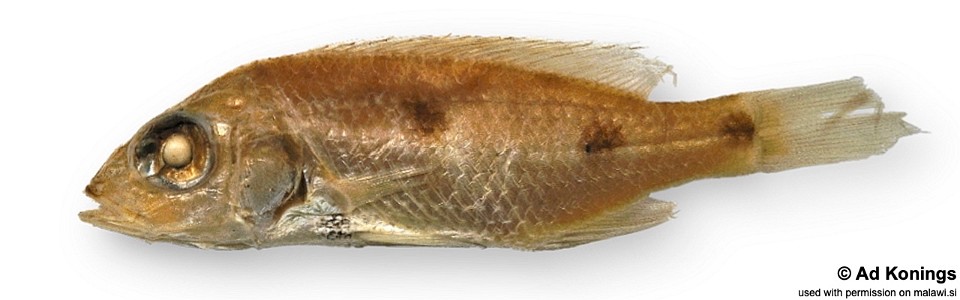

Transition habitats, mainly over sandy areas, with occasional use of rocky formations. A
lek-like breeding aggregation on sand adjacent to a reef is described at about 25 m depth.
Geographic distribution:
Historically known only from the type specimen collected at Lupembe; additional specimens
were later collected at Ifungu (Kirondo), Tanzania.
Typical adult size:
Males reach about 20 cm, while females attain about 16 cm.
Sexual dimorphism:
Males grow larger than females.
Diet:
Carnivorous, feeding mainly on juvenile fishes and small cichlids. In aquaria a protein-rich
diet is recommended, including live or frozen foods, and prepared foods with a high protein content.
Breeding:
Mouthbrooder. A harem (1 male with 2 females) or a pair (1 male with 1 female)
is described as a suitable maintenance approach. A lek-breeding colony is described, with many
territorial males each defending a bower on sand.
Aggression:
Strongly assertive. Females may be as intolerant of each other as males, and very small
tankmates may be treated as prey.
Special notes:
For many years the species was known only from a single small type specimen, and it was
questioned whether that type might represent a juvenile of another species. Later, two additional
specimens close to adult size were collected in Tanzania.
Photo gallery