Sandy-bottom habitats; non-breeding individuals are often encountered at about
20 m depth. Mouthbrooding females are typically found in the shallow
intermediate habitat.
Geographic distribution:
Endemic to Lake Malawi, with records from the southern part of the lake and from
Chizumulu Island; also recorded at Liuli in Tanzanian waters.
Typical adult size:
Up to about 25 cm total length, with males reaching slightly larger sizes
than females.
Sexual dimorphism:
Males are a few centimeters larger than females.
Recommended aquarium size:
An aquarium volume of at least 900 L and a minimum tank length of
250 cm are recommended.
Aquarium setup:
Provide ample open sand with fine grains so males can excavate a spawning dish.
It is strongly recommended to keep no more than one adult male per aquarium.
Diet:
Primarily chironomid larvae obtained by sifting sand; stomach contents have been
reported to include substantial sand grains and sediment ingested with the prey.
Breeding:
Breeding males excavate a deep crater used as a spawning dish, about 1.5 m
in diameter and roughly 60 cm deep, recorded at 30–35 m depth
(Mumbo Island and Tsano Rock). Males court females near the bower, and
mouthbrooding females withdraw to the shallow intermediate habitat and continue
caring for the young after first release.
Aggression:
Adult males show strong territoriality, especially in association with their sand
excavation and spawning area.
Special notes:
Distinguished from T. praeorbitalis by a deeper, more robust body,
a distinct black diagonal band, a larger mouth, and no yellow coloration. It has
been confused with T. praeorbitalis in the field; both species have
been recorded together while feeding.


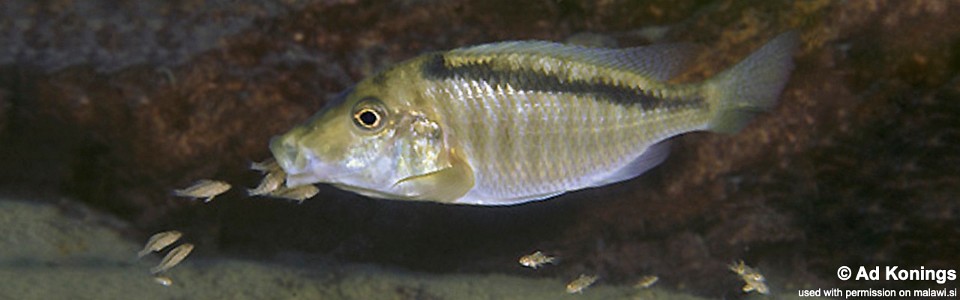




Photo gallery