Shallow sand and mud-sand habitats, including open sand as well as sandy areas close to rocks.
Geographic distribution:
Endemic to Lake Malawi; observed only in the southern part of the lake south of Nkhotakota, with records
from the Upper Shire River, but not from Lake Malombwe.
Typical adult size:
Up to about 30 cm total length in males; females only a few centimeters smaller.
Sexual dimorphism:
Males are slightly larger and, in breeding condition, show a light blue body with a greenish-blue snout.
Females do not show blue and often display a bright yellow snout and anal fin, with a yellowish wash on the flank.
Recommended aquarium size:
A very large aquarium is recommended; a minimum tank length of 250 cm is recommended, and an aquarium
volume of at least 900 L is recommended.
Aquarium setup:
Provide extensive open areas of fine sand for foraging and bower construction, with only a few scattered
rocks or small rocky plateaus; plants are best avoided because large individuals dig deeply and uproot
vegetation.
Diet:
A deep sand-sifter that feeds mainly on chironomid midge larvae; digging can reach about 10 cm into the
substrate, and sand, detritus, and diatom material may be ingested along with prey.
Breeding:
Males build very large sandcastle bowers that may exceed 2.5 m in diameter, surrounded by a ring of
excavation pits; breeding has been observed in July and August at Cape Maclear, with bowers typically in
about 7–10 m depth and spaced more than 5 m apart on average.
Aggression:
In aquariums males do not appear to be permanently territorial, but it is strongly recommended not to keep
more than one adult male together; avoid tankmates that resemble each other in male breeding coloration.
Special notes:
The type locality was historically given broadly as “Lake Nyassa” due to unlabeled museum material, but a
later note from the collector indicated Domira Bay. In the wild, the species is vulnerable to capture by
beach seines because it regularly uses shallow water; it remains common around Cape Maclear, yet its large
size makes it a valued food fish and it may be susceptible to overfishing.
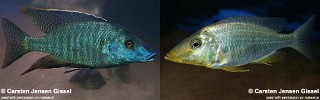
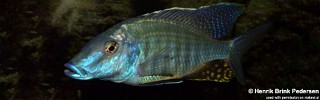

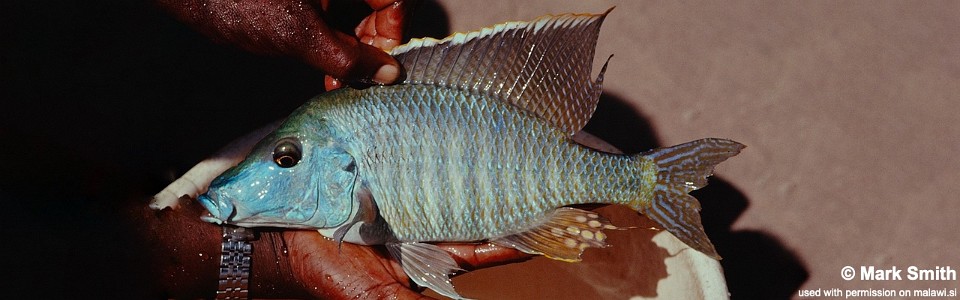




Photo gallery