Sediment-free rocky habitat at 5–25 m, with large boulders creating caves and crevices used as
shelter and spawning sites.
Geographic distribution:
Known from Zimbawe Rock and from a tiny rocky reef just south of Mumbo Island (Chimney Rock).
Typical adult size:
In the wild, males are estimated to reach about 13 cm
total length, while in aquaria they may grow a few centimeters larger; females remain about 1-2 cm smaller.
Sexual dimorphism:
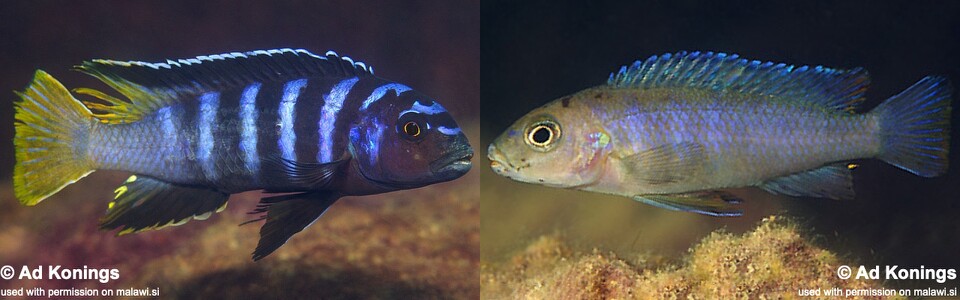
Males in territorial coloration are light blue with 5–6 distinct black bars; head black with two
light-blue interorbital bars and a dark brown throat. Pelvic fins black; anal fin black; dorsal fin black
with yellow to orange distal spots. Caudal fin is yellow in the type-locality population (Zimbawe Rock);
males at Chimney Rock may show a blue tail. Females are beige-brown to light blue without distinct bars,
with a white to beige belly and breast; head beige to brown with blue-green highlights, green to light gray
interorbital bars, and a white throat.
Recommended aquarium size:
300 L (minimum length 120 cm).
Aquarium setup:
Provide extensive rockwork with many caves and hiding places; ensure at least one cave per male.
Fine sand is preferred. Keep with other robust omnivorous mbuna. Males can be highly territorial; avoid
multiple adult males unless the aquarium is very large and offers strong visual barriers.
Diet:
Omnivorous. Grazes aufwuchs (diatoms and cyanobacteria strands) from rocks and frequently feeds
on plankton in open water; stomach-content studies have shown plankton can form a large part of the diet.
Breeding:
Territorial males defend caves between rocks; territories may be close together in suitable
habitat. Spawning takes place inside the male’s cave. Females are maternal mouthbrooders; broods are
typically 10–30 eggs, with release after about three to three and a half weeks, followed by abandonment.
Aggression:
Very aggressive within the species. Toward other species, aggression is usually most pronounced
around spawning time.
Special notes:
The elongate body form is associated with life in crevices between rocks.
Photo gallery