Sediment-rich rocky habitat, including rocky areas with sand–rock
interfaces where the fish remains close to rocks while foraging.
Geographic distribution:
Endemic to Chizumulu Island, Malawi, and the surrounding reefs, including
Chiwi Rocks and Linganjala Reef.
Typical adult size:
Males reach up to about 12 cm total length, while females remain smaller,
typically around 10 cm. In the aquarium, males may grow to 16 cm or more.
Sexual dimorphism:
Males are greyish-blue with 7–9 yellow vertical bars and an orange-tinged
head, while females are more subdued in coloration, appearing yellowish
to brownish without strongly contrasting bars.
Recommended aquarium size:
300 liters.
Aquarium setup:
The aquarium should be dominated by rockwork arranged to form numerous
hiding places and territories. For each male, it is recommended to keep
two to three females to distribute aggression.
Diet:
Primarily herbivorous, feeding on algae scraped from rocks (aufwuchs),
but also consuming plankton from the water column.
Breeding:
Breeding males defend rocky territories where spawning takes place.
Females are maternal mouthbrooders, incubating eggs and fry in the mouth
before releasing free-swimming juveniles.
Aggression:
Aggressive within the species, particularly among males, but generally
tolerant toward other mbuna species.
Special notes:
This species has a very restricted distribution and is closely associated
with Chizumulu Island.
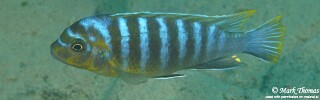
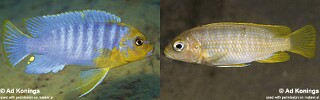
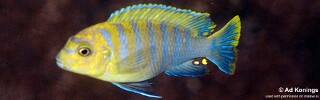
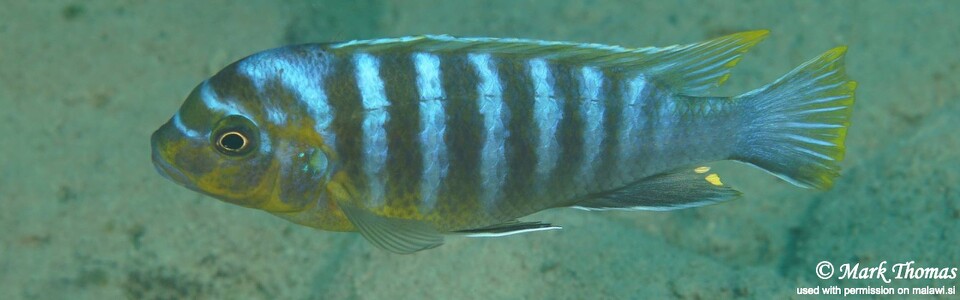



Photo gallery