Sediment-rich intermediate rocky habitat with sand–rock interfaces,
occurring on rock reefs where rocks are small.
Geographic distribution:
Known only from Membe Point and Maingano Island along the northeastern
shore of Likoma Island, Lake Malawi.
Typical adult size:
Males reach about 8 cm total length, while females remain smaller at
approximately 6 cm.
Sexual dimorphism:
Males have blue flanks and a dark submarginal band in the dorsal fin,
while females are brownish yellow and lack the submarginal band.
Recommended aquarium size:
300 liters.
Aquarium setup:
The aquarium should contain plenty of rocks arranged to form hiding
places and territories. Fine sand is recommended as substrate so males
can excavate burrows. It is advised to keep one male with two to three
females.
Diet:
Omnivorous, feeding primarily on aufwuchs scraped from rocks and also
consuming plankton from the water column.
Breeding:
A maternal mouthbrooder. Males hold territories among small rocks or
alongside single rocks in the sand, where sand-scrape nests may be dug.
Females are non-territorial and usually solitary.
Aggression:
Aggressive within the species, especially among males, but generally
tolerant toward other species.
Special notes:
This is a small, deep-water mbuna with a very limited distribution and
low population density.
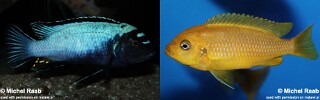
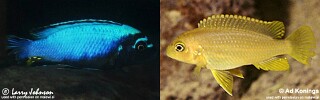
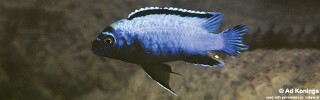
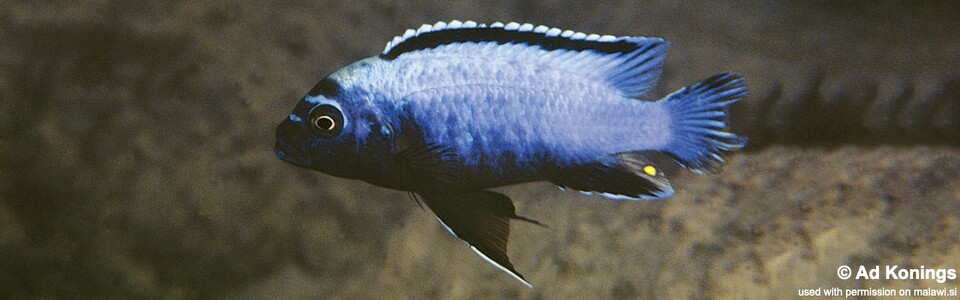



Photo gallery