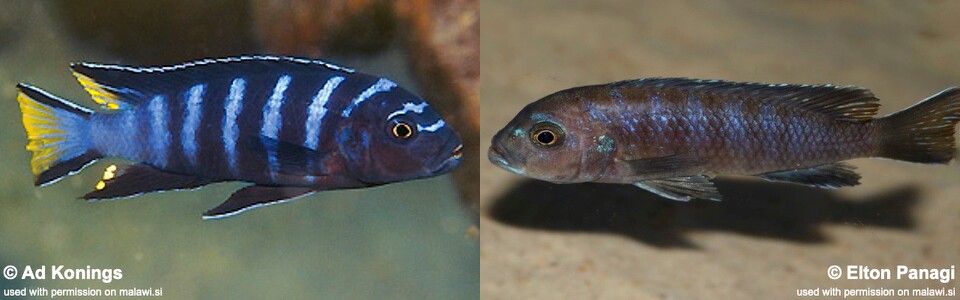
Sediment-free shallow rocky habitat. The species is adapted to life in caves and narrow
crevices among rocks and is often observed foraging from vertical rock faces or from
the ceilings of caves.
Geographic distribution:
Lake Malawi at Linganjala Reef and Chizumulu Island.
Diet:
Feeds from the aufwuchs using the typical Maylandia-type feeding mechanism.
Foraging is usually carried out on vertical substrates and within caves. Feeding
territories are not defended.
Sexual dimorphism:
Females are beige brown, sometimes with a bluish hue, and lack a black submarginal band
in the dorsal and anal fins. Males show the typical zebra-like pattern combined with
a yellow tail in breeding dress.
Aggression:
Generally less aggressive than zebra-type mbuna. The species does not defend feeding
territories.
Special notes:
This species belongs to the elongate Maylandia group, which was formerly placed
in Pseudotropheus based mainly on body shape. Detailed observations of feeding
behavior and skull morphology support its placement in Maylandia. The elongate
body form represents an adaptation to cave-dwelling and crevice-oriented life rather
than close relationship to the classic zebra species.
Photo gallery