Shallow, sediment-free rocky habitat. Inhabits cracks and small caves among rocks,
mostly at depths between 7 and 15 m, but reported from very shallow water down to
greater depths in some areas.
Geographic distribution:
Confirmed from Mbamba Bay to Maunyuni Rocks along the Tanzanian coast of Lake Malawi.
Additional populations possibly occur elsewhere in the lake, but their identity
remains uncertain.
Typical adult size:
Males up to about 10–11 cm; females slightly smaller, up to about 8 cm.
Sexual dimorphism:
Males are larger and more intensely colored. Females are smaller and brownish with
a weaker bluish hue.
Recommended aquarium size:
At least 300 L; larger aquaria recommended for groups.
Aquarium setup:
Rock-dominated aquarium with many caves and crevices. Rockwork should extend high
toward the water surface. One male with several females is recommended, or larger
groups in suitably large tanks (500 L or more). Compatible with robust mbuna species.
Diet:
Aufwuchs feeder. Consumes algae, diatoms, and microorganisms scraped from rock
surfaces. Diet should be primarily vegetable-based.
Breeding:
Maternal mouthbrooder. Specific breeding behavior is poorly documented, but
territoriality appears weaker than in many other elongatus-group mbuna.
Aggression:
Strongly aggressive toward conspecifics; relatively tolerant toward other species
except during breeding periods.
Special notes:
The true identity and distribution of Chindongo elongatus have long been confused
with other elongatus-group mbuna. The species rediscovered at the type locality is
less aggressive and more secretive than forms historically exported under this name.

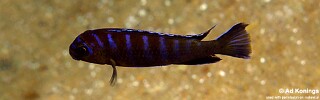


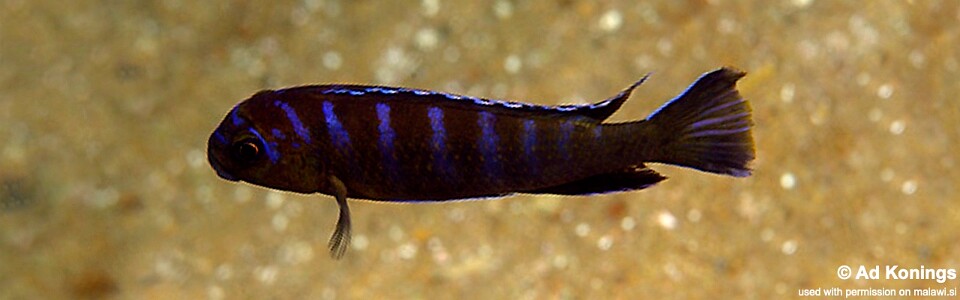




Photo gallery