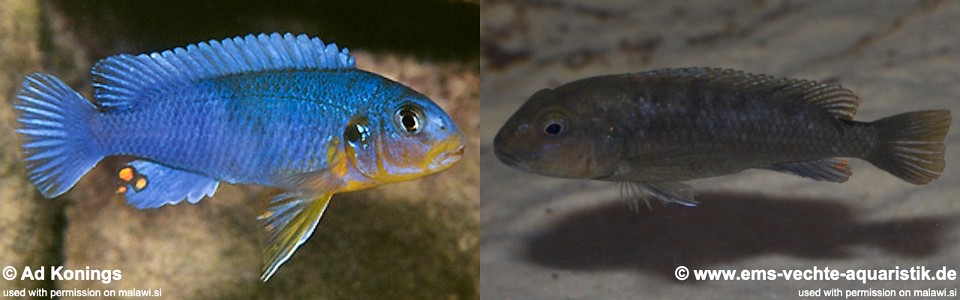

Sediment-free rocky habitat.
Typically occurs over rock and stony substrates in shallow water, often near the rock–sand interface.
Geographic distribution:
Tanzania coast of Lake Malawi.
Reported from Pombo Rocks and also from Undu Point / Undu Reef (likely wider than a single locality, but exact range remains uncertain).
Typical adult size:
Males up to about 9 cm, females around 7 cm total length.
Sexual dimorphism:
Males are slightly larger and more intensely colored (blue with brown-yellow throat/breast to head markings).
Females are smaller and duller, with shorter fins.
Recommended aquarium size:
250 L (minimum 200 L).
Aquarium setup:
Provide abundant rockwork with many crevices and caves for territories and shelter.
Use fine quartz sand as substrate.
Keeping a group helps spread aggression; ensure many visual barriers.
Diet:
Herbivorous aufwuchs grazer.
In nature feeds mainly on algae and biofilm from rocks.
In the aquarium offer vegetable-rich foods with spirulina/algae-based staples; avoid heavy animal-protein diets.
Breeding:
Maternal mouthbrooder.
Males defend small territories centered on a rock crevice or cave; females are generally solitary and not strongly site-loyal.
Aggression:
Aggressive toward conspecifics and can be nippy toward other mbuna.
Best kept with robust tank mates and plenty of structure to break line of sight.
Special notes:
Very similar to the “pseudoperspicax/perspicax-like” complex; identification is frequently confused in the hobby.
The brown-yellow head/throat/breast marking can vary between individuals (from throat/chest up onto the head), which has contributed to trade-name confusion.
Photo gallery