Rocky and intermediate habitats.
Most common in deeper, sediment-rich rocky zones below 15 m.
Males defend small caves among medium-sized rocks.
Females and non-territorial males feed in open water but stay close to rocks.
Geographic distribution:
Central and eastern Lake Malawi.
Occurs around Likoma, Chizumulu and Mbenji Islands and along the central eastern shoreline
from Undu Point (Tanzania) to Makanjila Point (Malawi), including Mozambique waters.
Typical adult size:
Males up to about 12 cm total length.
Females up to about 10 cm.
In aquaria both sexes may grow slightly larger.
Sexual dimorphism:
Strongly pronounced.
Males are predominantly deep black with very wide vertical bars and a white dorsal margin.
Females are light silvery and clearly distinct from males.
Recommended aquarium size:
At least 300 L.
Aquarium setup:
Minimum tank length 120 cm.
Provide abundant rockwork with caves (at least one cave per male).
Fine sand substrate.
Ensure sufficient open swimming space.
Best kept in harems (1 male with 3–4 females) or large groups if introduced simultaneously.
Diet:
Omnivorous.
Females and non-territorial males mainly feed on plankton (algae, diatoms, zooplankton).
Territorial males remain close to their caves and supplement their diet with aufwuchs.
Breeding:
Maternal mouthbrooder.
Males defend caves among rocks.
Spawning takes place inside the cave.
Mouthbrooding females remain solitary and close to rocks.
No post-release parental care.
Aggression:
Highly aggressive toward conspecifics and similar-looking species.
Aggression is strongly linked to territory (cave) defense by males.
Special notes:
True Cynotilapia afra is very rare in the aquarium hobby.
Most fish sold as “C. afra” are actually Cynotilapia zebroides.
Taxonomic confusion arose after 2013 when afra-forms were temporarily merged with zebroides, later corrected.
Occurs sympatrically with C. zebroides and C. aurifrons but is morphologically distinct.


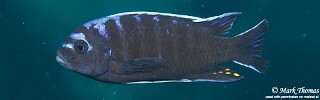


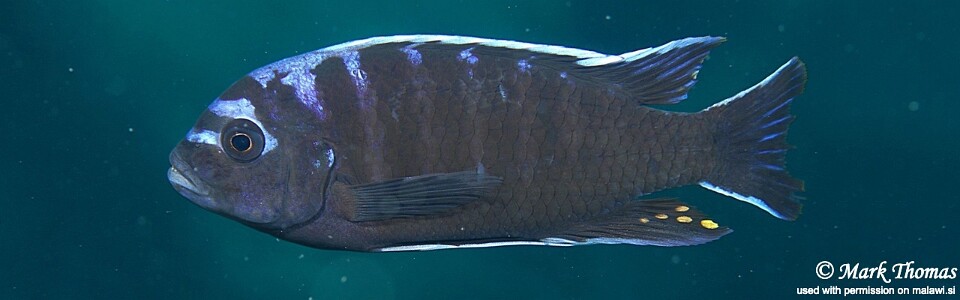




Photo gallery