Intermediate habitat dominated by sand with scattered larger rocks; occurs at depths of approximately 20–25 m
Typical adult size:
Males up to 11 cm; females up to 9 cm
Sexual dimorphism:
Males show blue and black vertical body striping, a black-and-white dorsal fin, and in some individuals a yellow lower abdomen; females are brown to grey-brown with faint blue vertical lines
Recommended aquarium size:
Minimum 250 litres; larger tanks recommended for groups with multiple males
Aquarium setup:
Fine sand substrate with scattered larger rocks; rock density should be low, reflecting the natural habitat; harems of 1 male with 3–4 females recommended, larger groups possible only in aquaria exceeding 400 litres
Diet:
Omnivorous; feeds mainly on plankton as well as aufwuchs algae and associated microorganisms
Aggression:
Intraspecific aggression can be pronounced; generally tolerant towards other species, but may become highly aggressive during spawning
Special notes:
Undescribed form; formerly placed in the genus Pseudotropheus and later transferred to Cynotilapia based on dentition; considered part of the elongatus complex
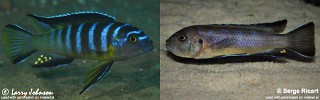
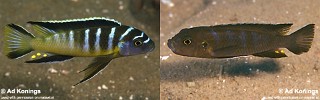
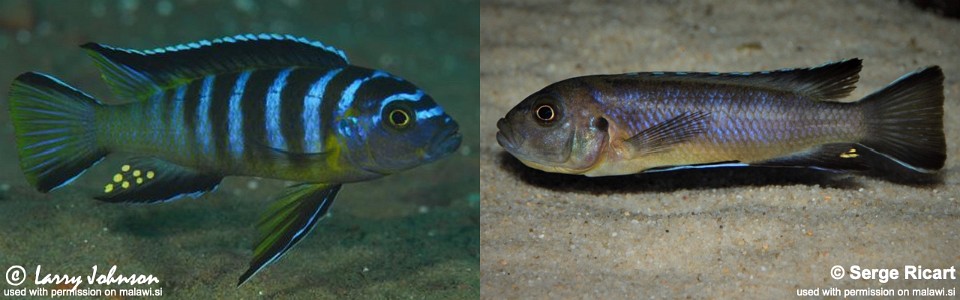




Photo gallery