Near Langenburg (Lumbila), Lake Nyassa (Lake Malawi).
Biotope:
Wave-washed upper rocky habitat,
including exposed rocky shores, islands, and rocky outcrops.
Also occurs on small rock patches within sandy areas,
particularly at wave-exposed sites.
Geographic distribution:
Found throughout the rocky and partly rocky coastlines of Lake Malawi.
Typical adult size:
Males up to about 18 cm in total length;
females are approximately one-quarter smaller.
Sexual dimorphism:
Males are larger and, when breeding,
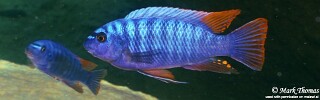
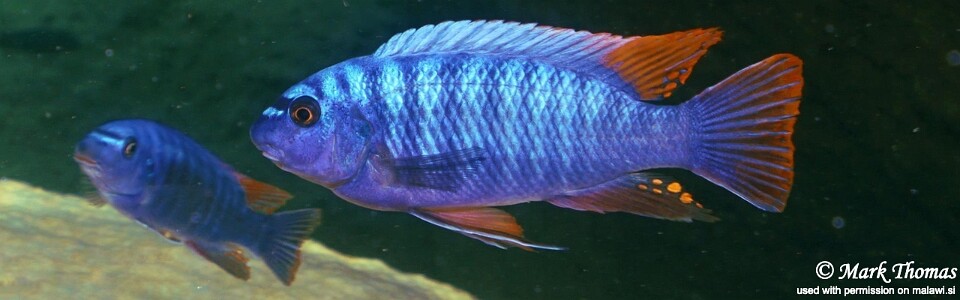
display a royal blue coloration with or without rusty orange patches.
Females are light brown,
often showing darker vertical bars on the flanks.
Recommended aquarium size:
Minimum aquarium volume of 600 liters.
Aquarium setup:
Aquarium with extensive rockwork forming caves and shelters,
combined with some open sandy areas.
Only one male should be kept per aquarium,
together with several females,
as males are highly aggressive toward conspecifics.
Diet:
Strictly herbivorous Aufwuchs feeder.
Grazes on algae tightly attached to rocks,
using its specialized mouth to crop algae very close to the substrate.
Breeding:
Maternal mouth-brooder.
Males defend territories vigorously.
Eggs are sometimes fertilized on the substrate
before being collected into the female’s mouth.
Fry are released after about three weeks
and may return to the female’s mouth for refuge.
Aggression:
Highly aggressive toward conspecifics,
especially between males.
Aggression toward other species increases during spawning.
Special notes:
Several species described by Pauers (2016, 2017) and Pauers & Phiri (2023)
are currently regarded as junior synonyms of Labeotropheus fuelleborni
rather than valid species. These include:
Labeotropheus chlorosiglos (Katale Island)
Labeotropheus artatorostris (Mumbo Island)
Labeotropheus alticodia (Maleri Island)
Labeotropheus obscurus (Namalenje Island)
According to Konings (2024),
these taxa were described mainly on the basis of male breeding coloration
or minor morphological differences,
all of which fall within the natural geographic variation of L. fuelleborni.
Measured characters largely overlap with those of typical L. fuelleborni,
and coloration patterns attributed to the “new species”
are known to occur at multiple, widely separated localities.
Furthermore, repeated lake-level fluctuations in Lake Malawi
have historically mixed populations,
allowing gene flow between color variants
that later became isolated again.
This process explains the observed diversity
without requiring species-level separation.
As a result, there is no consistent morphological, ecological,
or evolutionary evidence supporting these forms as distinct species,
and they are therefore treated as local variants
of Labeotropheus fuelleborni
rather than separate taxa.








According to Konings (2024), these taxa were described mainly on the basis of male breeding coloration or minor morphological differences, all of which fall within the natural geographic variation of L. fuelleborni. Measured characters largely overlap with those of typical L. fuelleborni, and coloration patterns attributed to the “new species” are known to occur at multiple, widely separated localities.
Furthermore, repeated lake-level fluctuations in Lake Malawi have historically mixed populations, allowing gene flow between color variants that later became isolated again. This process explains the observed diversity without requiring species-level separation. As a result, there is no consistent morphological, ecological, or evolutionary evidence supporting these forms as distinct species, and they are therefore treated as local variants of Labeotropheus fuelleborni rather than separate taxa.
Photo gallery