Rocky habitat, preferably free of sediment,
but also occurring in sediment-rich rocky areas.
Found from surface waters down to depths of about 40 m.
Geographic distribution:
Distributed throughout Lake Malawi.
Mostly occurs sympatrically with Labeotropheus fuelleborni,
but absent at Mbenji Island.
Present without L. fuelleborni at Jalo Reef,
Taiwanee Reef, and Linganjala Reef.
A small introduced population occurs at Mbuzi Island (Likoma).
Typical adult size:
Up to about 15 cm total length.
Females are approximately one quarter smaller than males.
Sexual dimorphism:
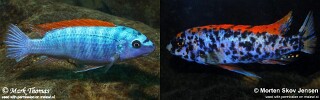
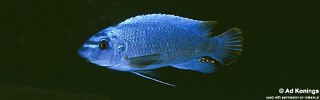
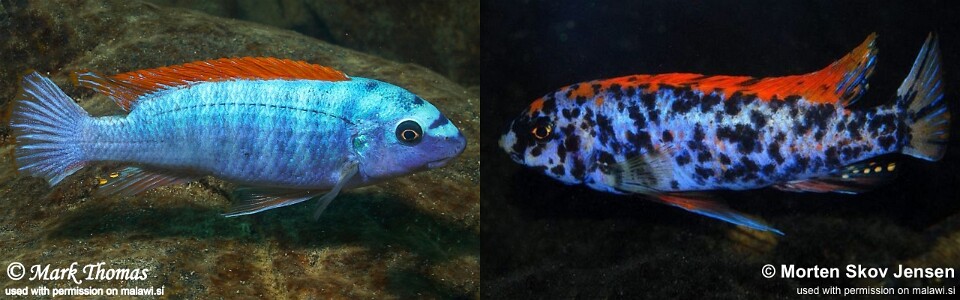
Males are larger and show several location-dependent color patterns,
including entirely blue forms,
blue with orange to red dorsal fin,
or blue with yellow, orange, or brownish coloration
on the flanks or upper body.
Females are predominantly orange-blotched (OB).
Rare OB males (MCAT) also occur in the lake.
Recommended aquarium size:
Minimum aquarium volume of 400 liters,
with a tank length of at least 150 cm.
Aquarium setup:
Aquarium with abundant rockwork forming caves and shelters,
combined with some open sandy areas.
Only one male should be kept per aquarium,
together with at least three to four females,
due to strong intraspecific aggression.
Suitable tankmates include other robust mbuna
such as species of Pseudotropheus, Melanochromis,
and Metriaclima.
Diet:
Strictly herbivorous Aufwuchs feeder.
Grazes on algae tightly attached to the substrate,
often feeding from vertical or overhanging rock surfaces.
In aquarium conditions,
the diet should consist primarily of Spirulina-based foods
and other high-fiber vegetable matter.
Breeding:
Maternal mouth-brooder.
Territorial males defend caves used as spawning sites.
Spawning takes place inside the cave,
while mouthbrooding females hide among rocks
and are rarely seen until fry are released.
Aggression:
Highly aggressive toward conspecifics,
particularly between males.
Aggression toward other species increases during spawning,
but outside breeding periods the species is relatively tolerant.
Special notes:
Several species described by Pauers (2016, 2017)
and Pauers & Phiri (2023)
are currently regarded as junior synonyms of Labeotropheus trewavasae
rather than valid species. These include:
Labeotropheus simoneae (submerged reef near Katale Island)
According to Konings (2024),
these taxa were described mainly on the basis of male breeding coloration
or minor morphological differences,
all of which fall within the natural geographic variation
of Labeotropheus trewavasae.
Diagnostic measurements largely overlap,
and coloration patterns attributed to the “new species”
are known to occur at multiple, widely separated localities.
Repeated lake-level fluctuations in Lake Malawi
have historically mixed populations during low stands,
allowing gene flow between different color variants.
Subsequent rises in lake level re-isolated populations,
producing local color forms without long-term evolutionary separation.
As a result, there is no consistent morphological, ecological,
or evolutionary evidence supporting these forms as distinct species,
and they are therefore treated as local variants
of Labeotropheus trewavasae rather than separate taxa.







According to Konings (2024), these taxa were described mainly on the basis of male breeding coloration or minor morphological differences, all of which fall within the natural geographic variation of Labeotropheus trewavasae. Diagnostic measurements largely overlap, and coloration patterns attributed to the “new species” are known to occur at multiple, widely separated localities.
Repeated lake-level fluctuations in Lake Malawi have historically mixed populations during low stands, allowing gene flow between different color variants. Subsequent rises in lake level re-isolated populations, producing local color forms without long-term evolutionary separation. As a result, there is no consistent morphological, ecological, or evolutionary evidence supporting these forms as distinct species, and they are therefore treated as local variants of Labeotropheus trewavasae rather than separate taxa.
Photo gallery