Labidochromis cf. caeruleus 'Thumbi Point' Labidochromis sp. 'blue white' Tanzania
Genus:
Labidochromis
Type locality:
Nkhata Bay, Lake Nyasa (Lake Malawi).
Biotope:
Pure rocky coasts at depths between 10 and 50 m,
typically inside caves and crevices.
It has also been found among weed beds in shallow water.
Geographic distribution:
Occurs on the western coast between Charo and Chizi Point
and on the eastern coast between Cape Kaiser and Lumbaulo.
The yellow color variant occurs in a small area of the northwestern shore,
between Charo and Kajizingi, south of Lion’s Cove,
and is not present in all populations within that stretch.
Typical adult size:
About 10 cm maximum in the wild;
in aquaria individuals can grow a few centimeters longer.
Recommended aquarium size:
200 L.
Aquarium setup:
Provide abundant rockwork with caves and crevices,
as the species naturally spends much time inside shelters.
More than one female per male is advisable,
but a 1:1 ratio or even more males than females is possible.
In community aquaria, several conspecific males can be kept together
if enough caves are available
and all males are introduced at the same time.
Diet:
Insectivorous.
Feeds on small crustaceans, insects, and their larvae,
twisting prey out of tiny cracks and pockets in rock surfaces
with long, pointed, pincer-like teeth.
Breeding:
No territorial males are observed in the wild.
Spawning takes place wherever male and female meet in the habitat.
Male and female show no difference in coloration.
Mouthbrooding females retreat into the rocky habitat
where they likely release their offspring.
Aggression:
Peaceful within the species and toward other species.
Special notes:
Although it is one of the most common Malawi mbuna in the aquarium hobby,
the species is very rare in Lake Malawi
and is usually encountered only inside caves in small numbers.
Increased collection of the yellow variant by exporters
has made this already rare fish even less likely to be seen underwater.
The yellow variant entered the hobby after two live specimens
were exported to Stockholm around 1980–1981
and later bred in large numbers.
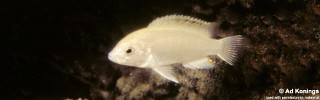
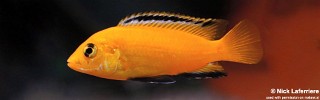
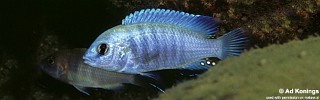
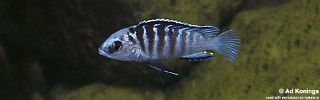
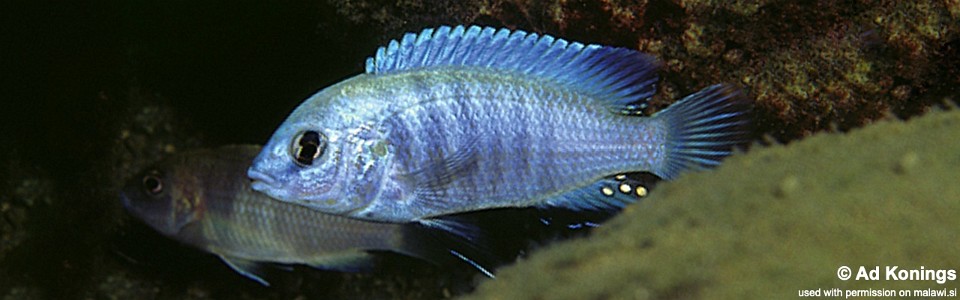




Photo gallery