Sediment-free, shallow rocky habitat,
mainly around small rocks.
Usually occurs at depths not deeper than 5 m,
but can sometimes be found as deep as 12 m.
Geographic distribution:
Restricted to the northeastern part of Likoma Island.
Introduced to Thumbi West Island at Cape Maclear in the 1970s.
Typical adult size:
Males up to about 8 cm total length;
females remain about 1 cm smaller.
Recommended aquarium size:
200 L.
Aquarium setup:
Aquarium with fine sand substrate
and ample rockwork providing caves and hiding places.
One male should be kept with two to three females.
Due to the small size of the species,
avoid housing it with larger and more robust mbuna.
Diet:
Omnivorous with a strong tendency toward algivory.
Feeds mainly on algae anchored to rocks,
extracting algae from small pockets and crevices
using long, slender teeth.
Breeding:
Territorial males occur throughout the year.
Males defend a small cave in the rocky habitat
and lead females to the spawning site.
Most individuals occur singly, including females.
Aggression:
Males are aggressive within the species
and each male requires its own cave territory.
Generally peaceful toward other species.
Special notes:
Distinguished from other blue Labidochromis
by having bicuspid outer teeth.
Resembles Labidochromis zebroides and, to some extent, Labidochromis lividus,
but differs in dental characters and details of body shape and fin coloration.


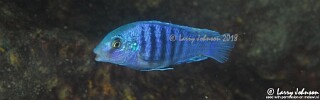





Photo gallery