Sediment-free rocky habitat,
most commonly at depths between 6 and 12 m.
Usually absent from the extreme shallows,
with juveniles occasionally occurring in the intermediate habitat.
Geographic distribution:
Restricted to Likoma and Chizumulu islands.
Introduced populations occur at Thumbi Island West
and possibly Otter Island.
Typical adult size:
Males up to about 12 cm total length;
females approximately one fifth smaller.
Sexual dimorphism:
Breeding males develop a black snout
and a black interorbital bar.
Females are indistinguishable from females
of other deep-bodied Labidochromis species.
Diet:
Primarily algivorous.
Feeds on filamentous algae from the aufwuchs,
pinching algae from small pockets in rocks
that are inaccessible to most other herbivores.
Breeding:
Territorial males occur throughout the year
and defend a small cave among the rocks.
Females are non-territorial and move through the habitat.
Mouthbrooding females retreat into rocky areas,
where the offspring are likely released.
Aggression:
Males are territorial and defend small areas,
primarily against conspecifics.
Special notes:
Part of the so-called “Gigas group” of deep-bodied Labidochromis.
Males of this group differ only slightly in bar and band patterns,
with Labidochromis gigas and Labidochromis sp. 'gigas cobwe'
showing the least pronounced markings.
The two forms are externally indistinguishable,
except for habitat preference:
Labidochromis gigas typically occurs deeper than 6 m,
whereas L. sp. 'gigas cobwe' inhabits very shallow water.
Introduced populations at Thumbi West Island
have shown little subsequent spread,
and the population reported from Otter Island
is thought to result from a separate introduction.


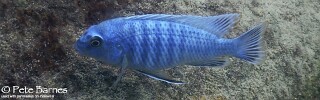





Photo gallery