Rocky habitat.
Most abundant around small rocks in very shallow water, usually less than 2.5 m deep.
Also occurs near larger rocks down to about 7 m, but is very rare below 4.5 m.
Geographic distribution:
Endemic to Likoma Island, Lake Malawi.
An introduced population is established at Thumbi West Island.
Typical adult size:
Up to about 9–10 cm total length;
specimens often grow larger in aquarium conditions.
Sexual dimorphism:
Strong.
Females and juveniles display orange-brown longitudinal stripes.
Males lose these stripes and become sky blue with dark bars in the dorsal and anal fins,
and grow larger than females.
Recommended aquarium size:
Minimum 250 liters is recommended;
larger tanks (300 liters or more) are preferable for community setups.
Aquarium setup:
Rock-dominated aquarium with many caves and hiding places.
Minimum aquarium length should be about 100 cm.
Keep one male with at least 3–4 females.
Avoid keeping together with similar-looking Labidochromis species to reduce the risk of hybridization.
Diet:
Omnivorous with a strong preference for invertebrates.
In nature feeds on insect larvae, nymphs, small crustaceans, and some algae from the Aufwuchs.
In aquarium conditions it readily accepts all foods and should be fed mainly a herbivore-based diet
to avoid obesity and excessive growth.
Breeding:
Maternal mouthbrooder.
Males court females by quivering and chasing intruders from the spawning site.
Females incubate about 20–30 eggs and fry in the mouth for roughly 3 weeks at around 25 °C,
often retaining the young longer than many vertically barred mbuna.
Aggression:
Moderately aggressive, especially among males of the same species.
Displays frequent chases and quarrels, but serious damage is uncommon.
Generally tolerant toward other mbuna species.
Special notes:
Labidochromis joanjohnsonae has one of the most complex and controversial taxonomic histories among mbuna.
Early descriptions were based on mixed material, leading to confusion and subsequent re-descriptions under
different genera, including Pseudotropheus and Melanochromis (as Melanochromis exasperatus).
Later revisions clarified much of this confusion, but the generic placement of the species remains debated.
Its rounded snout distinguishes it from typical Labidochromis, and it may ultimately belong to a separate,
yet undescribed genus.
Pending such a revision, it is generally retained in Labidochromis, where its closest relatives are still placed.
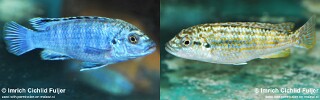
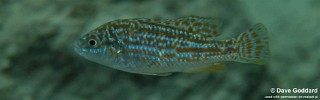
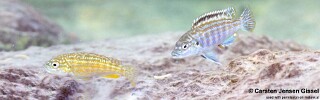
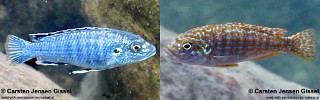
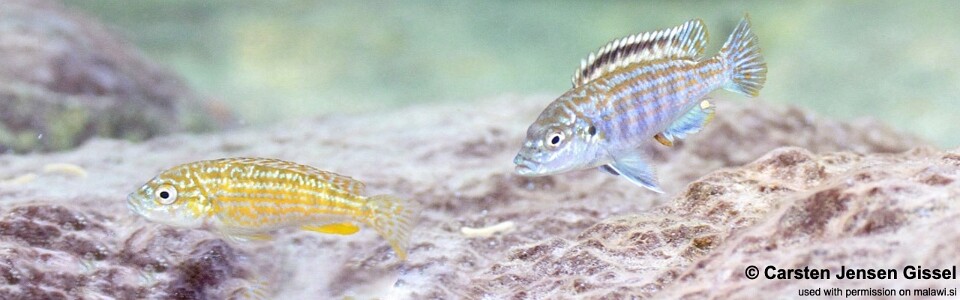




Photo gallery