Intermediate habitat at the interface between rock and sand.
Occurs mostly at depths of approximately 4–12 m, rarely entering deeper zones.
Geographic distribution:
Naturally distributed around Likoma Island, Mala Point (formerly Mara Point), Mbweca Rocks,
and Thumbi Point.
Also recorded at Nkolongwe, with no confirmed occurrences between Nkolongwe and Tumbi Point.
Native populations are present at Chizumulu Island, where the species occurs alongside other members of the
aurora group.
For the aquarium trade, specimens were also exported from Cobwé, north of Mala Point.
Introduced populations occur in the southern part of Lake Malawi, particularly around Thumbi West Island and
other localities along the Nankumba Peninsula between Otter Island and Tsano Rock.
Typical adult size:
Adult males usually reach about 10–12 cm, with females remaining approximately 1–2 cm smaller.
In aquaria, the species rarely exceeds 14 cm.
Sexual dimorphism:
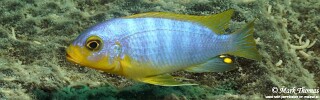
Adult males display a contrasting pattern of blue and golden yellow on the body and fins.
Females are light brown, sometimes with a faint bluish or purplish sheen.
Recommended aquarium size:
300 L.
Aquarium setup:
A rocky layout with numerous caves and hiding places is essential.
Keep at least three females per male; larger mixed groups are also possible.
The species is moderately aggressive, and aggression can be dispersed by keeping it together with other
algae-grazing mbuna.
Fine gravel or sand is recommended, allowing males to excavate spawning burrows.
Diet:
Herbivorous algae grazer.
Feeds primarily on algae growing on rocks (Aufwuchs), supplemented by phytoplankton and suspended organic
matter in the water column.
Breeding:
Territorial males excavate burrows beneath small rocks and defend them as spawning sites.
Females are mouthbrooders; spawning occurs inside the male’s burrow, after which females retreat and brood
their eggs while moving quietly among rocks near sandy areas.
Aggression:
Aggressive toward conspecifics, especially males.
Generally tolerant of other mbuna species, though males react more strongly to similarly colored rivals.
Special notes:
Member of the Maylandia aurora group, which occupies intermediate habitats along the
Lake Malawi shoreline.
Species of this group are characterized by the absence of a black submarginal band in the dorsal fin of
males and by generally light-brown females with yellow fin margins.
Females of aurora-group species are externally very similar and cannot be reliably distinguished by
coloration alone.








Occurs mostly at depths of approximately 4–12 m, rarely entering deeper zones.
Also recorded at Nkolongwe, with no confirmed occurrences between Nkolongwe and Tumbi Point.
Native populations are present at Chizumulu Island, where the species occurs alongside other members of the aurora group.
For the aquarium trade, specimens were also exported from Cobwé, north of Mala Point.
Introduced populations occur in the southern part of Lake Malawi, particularly around Thumbi West Island and other localities along the Nankumba Peninsula between Otter Island and Tsano Rock.
In aquaria, the species rarely exceeds 14 cm.
Females are light brown, sometimes with a faint bluish or purplish sheen.
Keep at least three females per male; larger mixed groups are also possible.
The species is moderately aggressive, and aggression can be dispersed by keeping it together with other algae-grazing mbuna.
Fine gravel or sand is recommended, allowing males to excavate spawning burrows.
Feeds primarily on algae growing on rocks (Aufwuchs), supplemented by phytoplankton and suspended organic matter in the water column.
Females are mouthbrooders; spawning occurs inside the male’s burrow, after which females retreat and brood their eggs while moving quietly among rocks near sandy areas.
Generally tolerant of other mbuna species, though males react more strongly to similarly colored rivals.
Species of this group are characterized by the absence of a black submarginal band in the dorsal fin of males and by generally light-brown females with yellow fin margins.
Females of aurora-group species are externally very similar and cannot be reliably distinguished by coloration alone.
Photo gallery