Primarily inhabits rocky habitats, including deeper rocky zones as well as sediment-influenced
areas and intermediate habitats. It is found from shallow water down to about 25 m depth.
Geographic distribution:
Occurs naturally along the northwestern coast of Lake Malawi between Kande Island and Ngara, and
along the northeastern coast between Puulu and Ikombe. Along the Tanzanian shoreline only the so-called
“Pearl” variant is present. In the southern part of the lake the species was introduced in the 1970s and is
now widespread around the Nankumba Peninsula, including Maleri and Nankoma islands, as well as Nakantenga
Island and Chidunga Rocks.
Typical adult size:
Males reach about 11 cm total length in the wild, while females remain roughly 10–20% smaller.
In aquaria, males may exceed 15 cm.
Sexual dimorphism:
At the type locality both sexes are blue and females can usually be recognized only when
mouthbrooding. In northern populations, clear sexual dimorphism occurs, with males ranging from cobalt blue
to pearl white, while females are cream-colored, white blotched, or occasionally blotched with pinkish-blue
tones, depending on locality.
Recommended aquarium size:
300 L.
Aquarium setup:
Provide abundant rockwork forming caves and visual barriers. A minimum tank length of about
125 cm is recommended. Stock one male with 3–4 females, or maintain larger groups in sufficiently large
aquaria. Although generally not highly aggressive, males can be aggressive toward conspecifics, and
aggression is best reduced by keeping them with other algae-grazing mbuna.
Diet:
Herbivorous algae grazer feeding mainly on Aufwuchs scraped from rocks, consisting largely of
algae and diatoms. It also feeds on plankton but usually remains closer to the substrate while doing so.
Breeding:
Males establish territories among rocks, with territories often spaced closely in dense
populations. Spawning takes place inside caves and is rarely observed. Females are maternal mouthbrooders,
remaining solitary while brooding for about three weeks. Fry initially stay together in small groups among
rocks before dispersing.
Aggression:
Aggressive mainly toward conspecifics, especially between males. Generally tolerant toward other
species, though aggression increases toward similarly colored mbuna.
Special notes:
Known in the aquarium hobby as “Cobalt Zebra” and “Pearl Zebra,” which represent color variants
of the same species rather than distinct taxa. Females of this species are unusual among mbuna in often
being blue or pale rather than brown, which may play a role in species recognition. Hybridization with
other Maylandia species has been documented both in aquaria and, locally, in the lake.
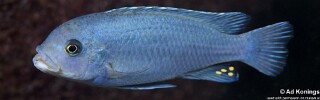


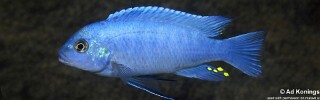





Photo gallery