Sediment-free upper rocky habitat, usually in shallow water and typically not deeper than about
8–10 m. At Minos Reef it is common around small rock groups scattered on sandy substrate, while breeding
males stay closer to larger rock formations; spawning caves are between rocks and only rarely on sand.
Geographic distribution:
Occurs along the eastern coast of Lake Malawi between Narungu (just south of the Nsinje River)
and Metangula, with a gap between Chiloelo and Nkhungu Reef. In this gap, at Lumessi, a very similar zebra
known as Maylandia sp. ‘estherae blueface’ occurs; this form may represent a geographical variant
of Maylandia estherae.
Typical adult size:
In the lake, females reach about 8 cm total length and males about 10 cm. In aquaria, males may
reach up to about 16 cm.
Sexual dimorphism:
Adult males are typically light blue to cobalt blue with no broad vertical bars; in some
populations males show yellow ocellated spots in the trailing part of the dorsal fin. Females range from
beige to brown, and many populations include orange (O) and orange blotched (OB) morphs; females may be
bright orange-red to orange-yellow or show black blotches on an orange background. Rarely, O-morphic males
occur and may appear pinkish to nearly white when courting; OB-morphic males are very uncommon.
Recommended aquarium size:
300 L.
Aquarium setup:
Provide extensive rockwork with caves and hiding places. Keep one male with 3–4 females, or
maintain larger groups in sufficiently large aquaria. It is considered among the more aggressive mbuna, so
aggression is best managed by housing it with other robust algae-grazing mbuna and by avoiding similarly
colored look-alikes.
Diet:
Feeds by combing loose Aufwuchs from algae matrix on rocky substrates with repeated strikes to
the substrate using a wide-open terminal mouth, taking short algal strands and diatoms. In captivity it
readily accepts prepared foods, but a strong plant component is emphasized, including spirulina and
algal-based items.
Breeding:
Males are territorial and defend rocky caves where females are led after courtship; spawning
takes place inside the cave and is usually not visible from outside. Females are maternal mouthbrooders and
hide between rocks while holding; nursery schooling is not described. Brood release after a roughly
three-week period is followed by abandonment of the fry. Fry released from red-colored females may include
both orange and brown individuals, with juveniles generally showing the adult female color pattern unless
normal pigment production is absent.
Aggression:
Aggressive within the species; generally tolerant toward other species but may show occasional
minor aggression.
Special notes:
In wild populations, blue males are the dominant male color form, while orange-red males are
very rare; in the aquarium hobby the situation is often reversed due to long-term selective breeding for
red males. Female color polymorphism is prominent, and the OB pattern is frequently encountered,
especially in females. At Minos Reef, two visually similar zebra-type species occur together, and males of
Maylandia estherae can be recognized there by yellow spotting in the dorsal fin.


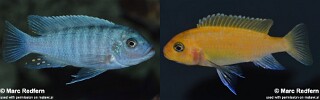


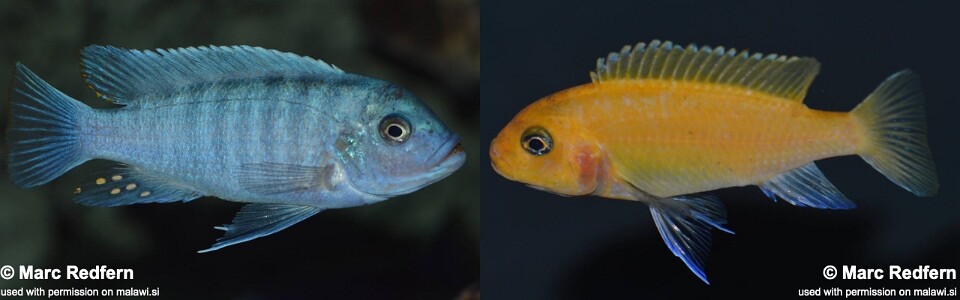




Photo gallery