Intermediate habitat of mixed rock and sand; recorded from about 5–40 m.
Non-breeding fish are generally in shallower parts of this range, while
territorial males are usually deeper than 20 m where the habitat contains
proportionally more sand than rocks.
Geographic distribution:
Reported along the northwestern shore between
Chewere and Chirwa Island (approximately 12 km), including Chitande Island
and nearby localities such as Katale Island, Chilumba Harbour, and the
Luromo Peninsula.
Typical adult size:
In the lake, males reach about 11 cm TL and females rarely exceed about 8 cm;
in the aquarium, males can attain up to about 15 cm TL.
Sexual dimorphism:
Males show bright yellow and/or blue ground coloration on flank and head,
whereas females have a light-brown ground color.
Recommended aquarium size:
Minimum tank length about 100 cm; larger aquaria are recommended when keeping
mbuna communities.
Aquarium setup:
Provide fine sand so males can excavate burrows, and abundant rocks arranged
into caves and shelters. Avoid keeping more than one adult male unless the
aquarium is very large, and avoid mixing the known geographical variants
because they will cross and females are difficult to distinguish.
Diet:
Grazes aufwuchs by combing loose material from the algal matrix; food is mainly
diatoms and small strands of cyanobacteria. When plankton is abundant,
territorial males as well as females and juveniles also feed in the water
column.
Breeding:
Maternal mouthbrooder. Breeding males defend a territory centered around a
burrow under a rock, or sometimes a cave between rocks; spawning takes place
inside the burrow or cave. Clutches are typically 10–25 eggs; females brood
for about three to three and a half weeks, release the young, and then
abandon them.
Aggression:
Generally calm toward other mbuna; adult males are mainly aggressive toward
other males and may be aggressive toward other species when ready to spawn.
Special notes:
Three geographically separated variants have long been recognized in the hobby
(formerly traded as “Elongatus Bee”, “Elongatus Chailosi”, and “Elongatus
Chewere”) and differ primarily in male breeding coloration; current treatment
considers them geographical variants because consistent morphological
differences were not found.


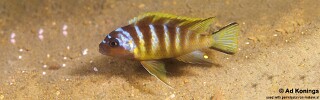
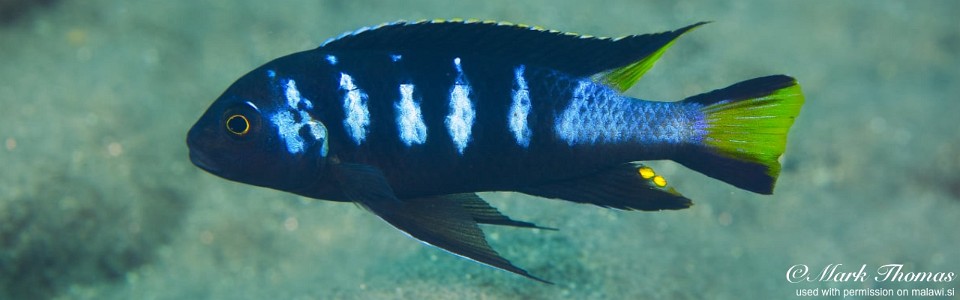




Photo gallery