Intermediate habitat at depths of approximately 7–20 m, consisting of a
mixture of rocks and sand. The sandy bottom and rocks are often covered by a
layer of fine sediment, and the substrate usually slopes gently toward deeper
water.
Geographic distribution:
Occurs along the Mozambique shore of Lake Malaŵi, with confirmed
populations at N’kolongwe, Thundu, Nkhungu, Chiloelo, and Charlie’s Bay.
Typical adult size:
In the lake, males reach about 10.5 cm total length while females are
roughly 25% smaller and rarely exceed 8 cm. Under captive conditions, both
sexes may grow up to about 2 cm larger.
Sexual dimorphism:
Sexes differ clearly in coloration. Males are larger and display a blue
to yellow flank with 6–9 black vertical bars, yellow pigment on the cheek and
breast, and a black submarginal band in the dorsal fin. Females are smaller,
bluish-brown to beige, with darker bars and also show a black submarginal band
in the dorsal fin, making them indistinguishable from females of
Maylandia lundoense.
Recommended aquarium size:
At least 300 liters, with a minimum tank length of about 120 cm.
Aquarium setup:
A rocky layout with numerous caves and crevices created by piled stones.
One male should be kept with several females (ideally 3–4). Due to strong
intraspecific aggression, more than one male should not be housed together.
Suitable tankmates are other robust mbuna, while closely related or very
similar-looking species should be avoided to reduce aggression and the risk
of hybridization.
Diet:
Primarily herbivorous. Feeds mainly on phytoplankton and on diatoms and
cyanobacteria combed from the aufwuchs on rocks, occasionally browsing loose
algae from the substrate.
Breeding:
Territorial males defend a burrow beneath a rock or among small rock
piles. Females visit the male’s territory for spawning, which takes place
inside the burrow. Females are maternal mouthbrooders and usually remain
solitary while incubating, hiding among rocks in the intermediate habitat.
Aggression:
Highly aggressive toward conspecifics and also toward other species,
especially between males defending territories.
Special notes:
Several populations formerly treated as separate, undescribed taxa—
Metriaclima sp. ‘black dorsal chiloelo’,
Metriaclima sp. ‘black dorsal nkhungu’,
Metriaclima sp. ‘black dorsal nkolongwe’, and
Metriaclima sp. ‘black dorsal thundu’—are now regarded as geographical
variants of a single species, Maylandia nigrodorsalis. Morphological
analyses failed to support species-level separation, and differences among
populations are interpreted as geographic color variation rather than
distinct species.

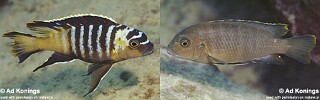






Photo gallery