Rocky habitat, typically at somewhat greater depths than many zebra-like mbuna.
The species is usually found in deeper rocky zones, often at depths of 10 m or more,
where large caves and close contact with the rocky substrate are common.
Geographic distribution:
A very wide distribution in Lake Malawi south of the Rukuru River on the western
shore and south of the Ruhuhu River on the eastern shore. Recorded localities include
Thumbi Point and Puulu in Tanzania; Tumbi Point, Mbweca, Minos Reef, Nkhungu Reef and
ChiloeIo in Mozambique; and Hora Mhango, Charo, Kakusa, Likoma, Chizumulu and Taiwanee
Reef in Malawi.
Sexual dimorphism:
Females are brown to dark brown and show little or no vertical barring. Males exhibit
a zebra-like pattern with distinct vertical bars and a prominent black submarginal
band in the dorsal fin.
Diet:
Males feed mainly on Aufwuchs scraped from rocks, but also consume plankton when it
is available in sufficient quantities.
Breeding:
Males are strongly territorial and defend their spawning sites with great vigor.
Aggression:
Highly aggressive toward intruders around spawning sites. Despite this, the species
is generally shy, living solitary and remaining close to the rocky substrate.
Special notes:
This undescribed species belongs to a group of zebra-like mbuna characterized by a
prominent black submarginal band in the dorsal fin and relatively large, widely
spaced teeth in the outer jaw rows, a feature that appears intermediate between
typical Maylandia and Cynotilapia. Although its precise relationship to
Maylandia sp. ‘chinyankwazi’ is unclear and the two may be closely related,
all similar-looking populations outside the range of that species are assigned to
Maylandia sp. ‘aggressive bars’. The species is nowhere very common, with the
possible exception of the population at ChiloeIo, and is noted for its shy behavior,
often occupying large caves in deeper rocky habitats.
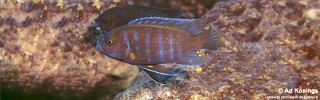
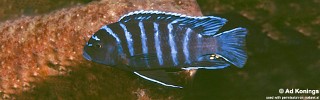
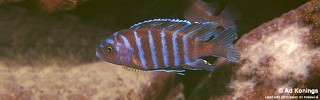
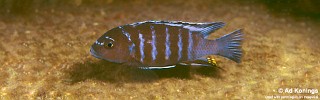
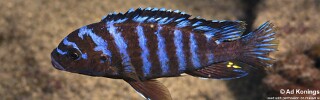
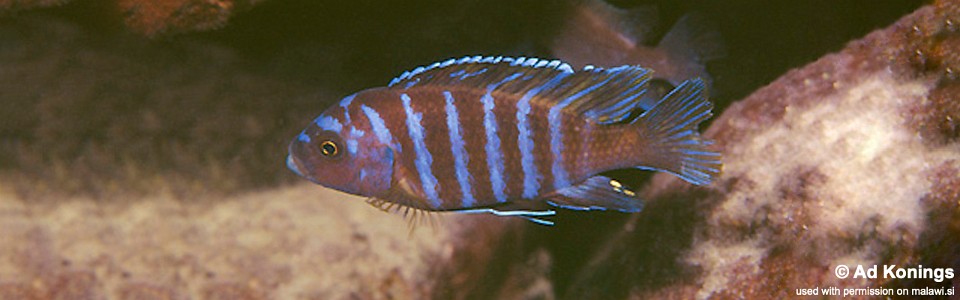




Photo gallery