Maylandia sp. 'chinyankwazi' Chinyamwezi Island Metriaclima sp. 'chinyankwazi' Chinyamwezi Island
Genus:
Maylandia
Biotope:
Rocky habitat, usually at greater depths than many other zebra-like mbuna. The species
occurs mainly in deeper rocky zones, often at depths of 10 m or more, where individuals
stay close to the substrate and frequently occupy large caves.
Geographic distribution:
Lake Malawi at Chinyankwazi Island, Chinyamwezi Island, Boadzulu Island and Makokola
Reef. Populations from Boadzulu Island and Makokola Reef were previously referred to
as Maylandia sp. ‘boadzulu’ but are now regarded as further populations of
Maylandia sp. ‘chinyankwazi’.
Sexual dimorphism:
Females are brown to dark brown and show little or no vertical barring. Males exhibit
a zebra-like pattern with distinct vertical bars and a prominent black submarginal
band in the dorsal fin.
Diet:
Males feed primarily on Aufwuchs scraped from rocks and also take plankton when it is
available. Females at Chinyankwazi and Chinyamwezi are reported to school in mid-water
and feed mainly on plankton.
Breeding:
Males defend spawning sites with great vigor, maintaining territories associated
with rocky structures.
Aggression:
Strongly territorial around spawning sites. Southern populations are described as
shy mbuna that live solitary and remain close to the rocky substrate.
Special notes:
This undescribed species is part of a group of zebra-like mbuna characterized by a
distinct black submarginal band in the dorsal fin and relatively large, widely spaced
teeth in the outer jaw rows. Its relationship to Maylandia sp. ‘aggressive bars’
is unclear and the two may be closely related, but they are treated as separate taxa
due to differences in distribution and behavior.
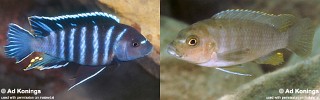
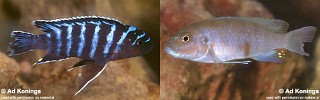
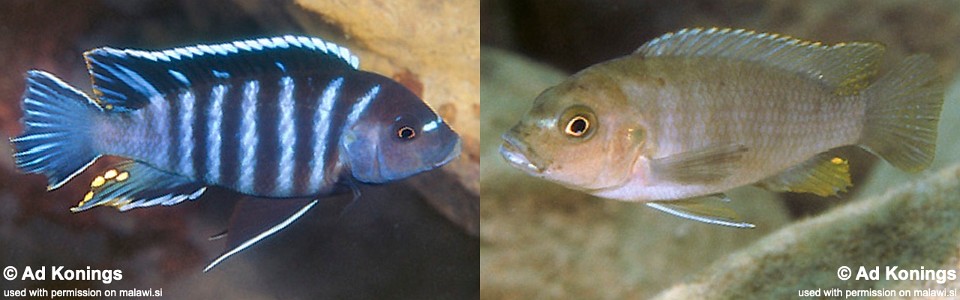




Photo gallery