Maylandia sp. 'daktari' Hai Reef Metriaclima sp. 'daktari' Hai Reef
Genus:
Maylandia
Biotope:
Intermediate habitat along the northeastern shores of Lake Malawi and adjacent areas,
typically at depths between about 5 and 15 m, with a mix of rocks and sand.
Geographic distribution:
Occurs at Undu and Hai reefs in Tanzania and at Chiwindi and Liutche in Mozambique.
Typical adult size:
Approximately 9 cm for males and about 7 cm for females.
Sexual dimorphism:
Males and females differ in coloration. Males from Tanzanian populations are completely
yellow, while males from Mozambique show a light yellow body with a blue sheen.
Females are beige in Tanzania and yellowish in Mozambique.
Recommended aquarium size:
At least 200 liters.
Aquarium setup:
The aquarium should not be smaller than 200 liters and should include a structured
layout of rocks and sandy areas that mimic the natural intermediate habitat. Keeping
the species in a somewhat larger group is recommended.
Diet:
Herbivorous. In the wild, the species feeds mainly on algae (Aufwuchs), but plankton
is also taken. In aquarium conditions, it accepts a variety of foods based on
vegetable ingredients, with spirulina recommended as a supplement.
Breeding:
No specific breeding behavior is described beyond typical mbuna reproduction.
Aggression:
Generally relatively peaceful, with occasional aggression occurring mainly within
the species.
Special notes:
This undescribed species belongs to the so-called lime group of Maylandia, whose
members have bicuspid teeth but a morphology and behavior reminiscent of
conical-toothed Cynotilapia. It is closely related to
Maylandia sp. ‘lime’ and Maylandia sp. ‘lime nkhomo’, with males of these
taxa showing very similar color patterns. Two geographical races are known, differing
mainly in male and female coloration between Tanzanian and Mozambican populations.
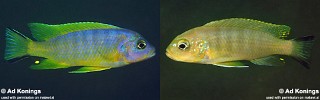
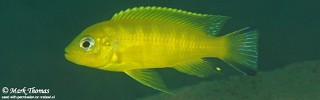
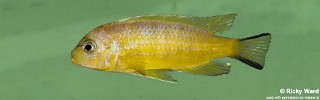
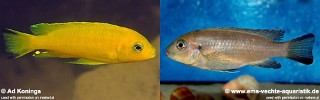
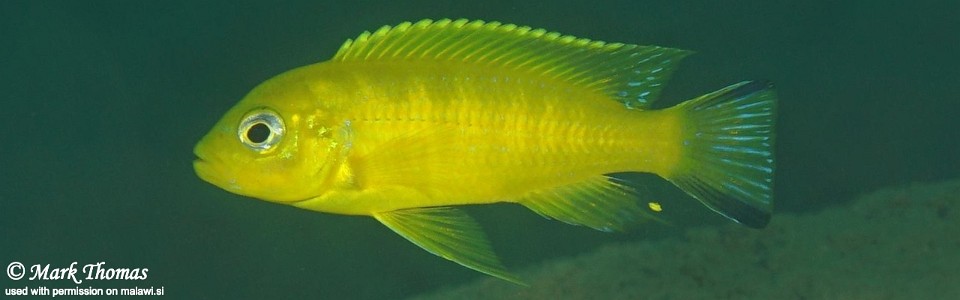




Photo gallery