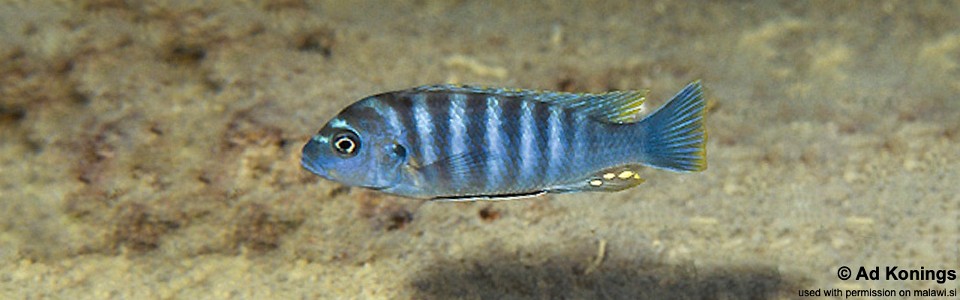

Deep sandy intermediate habitat with small heaps of stones scattered on a vast sandy
bottom. The habitat is less sediment-rich than that of related forms from the Maleri
Islands and is typically found at depths exceeding 25 m.
Geographic distribution:
Northern part of Lake Malawi in Tanzanian waters, recorded from Lupingu and Manda,
both north of the Ruhuhu River, and also from Puulu Island near Liuli.
Diet:
Feeds predominantly on plankton. Some territorial males have been observed feeding
from the biocover on rocks or even from sand, but most individuals rely on plankton
while remaining close to the substrate.
Breeding:
Territorial males establish and defend spawning sites associated with stones or small
rock heaps, although detailed spawning behavior has been only sparsely observed.
Aggression:
Generally non-aggressive, with territorial behavior mainly limited to the immediate
area around spawning sites.
Special notes:
This small, stocky mbuna closely resembles Maylandia sp. ‘dumpy’ in shape and
behavior and was previously regarded as a population of that taxon. Due to the very
large geographic separation between their ranges, it is treated as a distinct
species. Compared to the Maleri Islands form, this species inhabits deeper, less
sediment-rich sandy habitats and relies more strongly on plankton feeding. Although
superficially similar to Cynotilapia sp. ‘lion ntekete’, it differs by possessing
bicuspid teeth and is therefore placed in Maylandia.
Photo gallery