Maylandia sp. 'msobo heteropictus' Lundo Island Metriaclima sp. 'msobo heteropictus' Lundo Island
Tribe / Genus:
Maylandia
Biotope:
Rocky habitat at depths ranging between 7 and 25 meters.
Geographic distribution:
Lake Malawi (Tanzania and Mozambique): found between Njambe and Lundo Island,
with additional records from Higga Reef south of Lundo Island.
Typical adult size:
Males up to about 12 cm total length; females up to about 10 cm.
Sexual dimorphism:
Males are blue with a highly variable pattern of vertical bars that do not
extend over the entire flank, leaving the upper body light blue.
Females are white-yellow with a yellow anal fin.
Recommended aquarium size:
350 L, with a minimum aquarium length of 150 cm.
Aquarium setup:
Provide abundant rockwork with many hiding places. One male should be kept
with 3–4 females, or maintained in groups such as 3 males with 7 females.
It is recommended to house them together with other algivorous mbuna.
Diet:
Herbivorous algivore. Feeds primarily by combing algae from rocks
(aufwuchs), while females also consume plankton.
Breeding:
Breeding behavior follows the typical Maylandia pattern, with males
defending territories on rocky substrates used as spawning sites.
Aggression:
Aggressive within the species, generally tolerant toward other species.
Special notes:
This species belongs to the black-dorsal group and was previously associated
with the so-called “Msobo Trio”. Its distribution is separated from that
of Maylandia sp. ‘msobo’ by sandy shores that act as a natural
barrier, and no intermediate forms between the two have been found.
Although some aspects of male coloration suggest a possible relationship
to Melanochromis, the feeding technique is unmistakably that of
Maylandia, combing algae tightly from the rock surface.
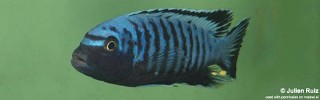
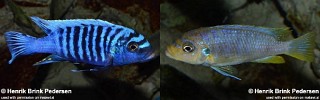
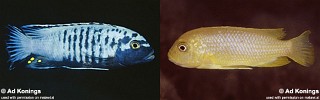
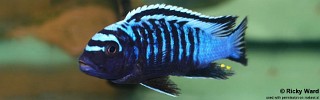
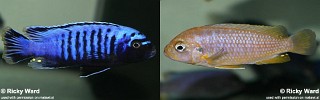
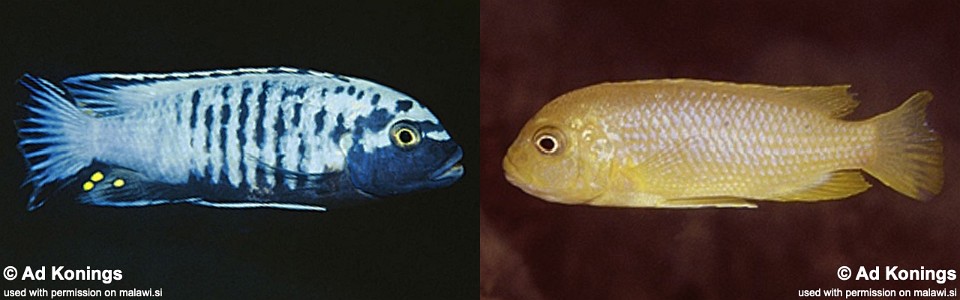




Photo gallery