Maylandia sp. 'patricki' Mbenji Island Metriaclima sp. 'patricki' Mbenji Island
Tribe / Genus:
Maylandia
Biotope:
Intermediate habitat at depths ranging between 5 and 25 meters,
consisting of scattered rocks on sand and sandy areas with some rocky
substrates.
Geographic distribution:
Southwestern Lake Malawi, including Chidunga Rocks (Chipoka),
the Maleri islands, Namalenje Island, the Mbenji islands,
Nkhomo Reef, and Jalo Reef near Nkhotakota.
Typical adult size:
Males up to about 11 cm total length; females up to about 9 cm.
Sexual dimorphism:
Males and females differ in coloration; males develop distinct
breeding dress and are permanently territorial, while females are
less intensely colored.
Recommended aquarium size:
300 L, with a minimum aquarium length of 130 cm.
Aquarium setup:
Tall rock structures should be provided in the background,
with a sandy area in the foreground. One male is kept with
2–3 females, or the species can be maintained in groups
such as 3 males with 7 females. It is a temperamental cichlid
that can be quite aggressive within the species, but is
relatively peaceful toward other species.
Diet:
Herbivorous, feeding on aufwuchs, including diatoms
and microorganisms found within the algal matrix on rocky
and sandy substrates.
Aggression:
Aggressive within the species; generally tolerant toward
other species.
Special notes:
This species is sometimes encountered over pure sand and is
considered intermediate between true sand-dwelling mbuna
and rock-dwelling mbuna. Unlike sand-dwelling forms, it shows
permanently territorial behavior. Breeding males are present
throughout the year and excavate holes beneath scattered stones
of the habitat, feeding from the aufwuchs on both rocky
and sandy substrates. Several populations with distinct coloration
are known, including forms from the Mbenji islands that are
exploited for the aquarium trade.
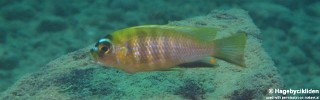
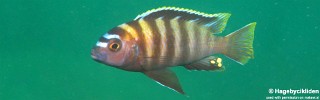
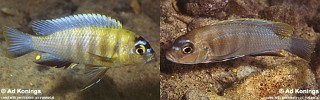
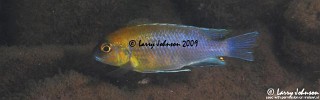
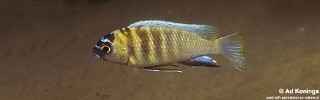
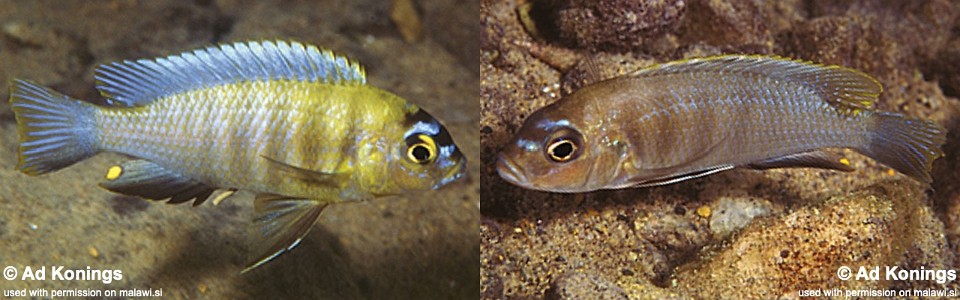




Photo gallery